

Table of Contents
Say a vegetable delivery business in Velachery launches a website in January. By March it has hundreds of product pages, a Google listing with two photos, and orders that still arrive mostly through WhatsApp. The site exists, yet nobody searching “vegetable delivery near me” from Velachery ever lands on it.
This article treats SEO strategies for online grocery stores in India as a sequence, not a menu. It covers ten tactics, ordered by what a small team can finish first and check within a month.
Push Digital, a Chennai-based 360° branding and digital marketing agency, wrote it for online grocers, D2C food brands and neighbourhood stores in Tamil Nadu. The order matters because a store that tunes its checkout before its delivery pages is polishing a shop customers cannot find.
Key Takeaway: Start with what shoppers inside your delivery radius can find: your Google listing and your delivery-area pages. Then fix catalogue pages, speed and trust details, and finish with festival pages and order tracking. Each step can be checked before the next begins, which suits small teams with one developer or none.
Why Do Grocery Searches Reward the Store That Is Nearby and Reliable?

Grocery searches reward nearby, dependable stores because people order to a deadline within a delivery radius. Google ranks local results mainly on relevance, distance and prominence, so a store with accurate areas, hours and stock is more likely to show up. Grocery store SEO therefore starts with location and trust, and keywords come second.
Google publishes the three factors in its guidance on improving local ranking, and grocery makes each one concrete. Relevance is how well your listing and pages match a query such as “milk delivery in Adyar”. Distance is outside your control. Prominence draws on reviews and on how many websites link to you.
A common setup in Tamil Nadu is a shop where WhatsApp ordering is the real checkout and the website sits beside it, unused. Two US-facing guides on SEO strategies for online grocery stores that we reviewed for this article never mention it. A website earns its place by offering what a chat cannot: live stock, delivery slots and a price the customer sees before asking.
Shoppers also type product names the way they say them at the counter, sometimes in English letters, such as “thakkali” for tomato. Catalogues that live only inside an app or behind a login give Google nothing to index. Every product, category and delivery area that should rank needs a public page with its own address.
Which SEO Strategies for Online Grocery Stores in India Should Come First?
Start with the strategies that decide whether nearby shoppers find you: a complete Business Profile, delivery-area pages and order tracking. Catalogue pages, speed and trust content come next because they convert visitors you already have. Festival pages and filter clean-up come later, since they need lead time or developer help.
Push Digital’s 4-Question Grocery SEO Priority Check is the method we recommend for ordering the ten strategies below. Score each strategy with four yes-or-no questions, and start with the ones that collect the most yeses.
- Reach: does it change what shoppers inside your delivery radius can find?
- Effort: can your own team finish it without a developer?
- Independence: can it start without another task finishing first?
- Proof: will Google Analytics 4, Search Console or your Business Profile show a result within a month?
The ten SEO strategies for online grocery stores in India that follow sit in four blocks: location, catalogue, trust, and timing with measurement. Applied to a typical small online grocer, the check produces this order, though your own scores may move a row if a developer is already on retainer.
| Strategy | Order to start | Deciding question |
|---|---|---|
| 1. Business Profile and listings | Start now | Reach |
| 2. Delivery-area pages | Start now | Reach |
| 3. Reviews that name the area | Next | Proof |
| 4. Category pages | Next | Reach |
| 5. Product pages and Product schema | Next | Independence |
| 6. Filters and stock handling | Later | Effort |
| 7. Mobile speed | Next | Proof |
| 8. Trust and compliance content | Next | Independence |
| 9. Festival pages | Schedule ahead | Independence |
| 10. Order tracking | Start now | Proof |
Own Your Delivery Radius Before Anything Else
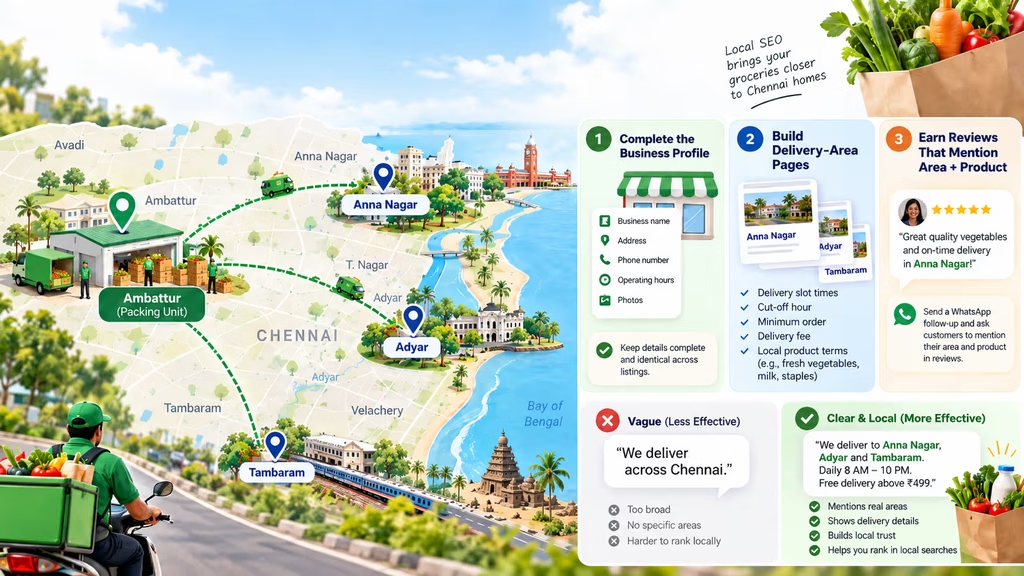
Take a staples brand that packs orders from one unit in Ambattur and delivers to Anna Nagar, Adyar and Tambaram. Its website says “we deliver across Chennai”. A shopper in Adyar cannot tell from that line whether the store reaches her, or by what time on a Saturday. Fixing it is the cheapest of the SEO strategies for online grocery stores in India, since it needs only facts you already hold.
Strategy 1: Complete the Business Profile and keep every listing identical
Local SEO for grocery delivery begins here. A Google Business Profile for grocery store delivery needs more than a name and a phone number. Google says businesses with complete and accurate information are more likely to appear in local results. It lists address, hours, business type and attributes as the details to fill. Give a full address only if customers can visit, and add special hours for festival days.
Keep name, address and phone number identical on your website, your Profile, Justdial and every delivery app you list on. That NAP consistency matters because mismatched details make it harder for search engines to treat two listings as one business.
Strategy 2: Build delivery-area pages that differ for each area
Grocery delivery area pages work when each one answers a local question: does the store reach this street, and by when? Define each delivery zone by locality or pincode, not “across Chennai”. Then give the page that zone’s slot times, cut-off hour, minimum order, fee, most-ordered items and a review from a customer there.
Pages that swap only the locality name add little, because two identical pages give a search engine no reason to prefer either. Name real localities such as Velachery or Porur, and use the Tamil and Tanglish product names people type.
Strategy 3: Earn reviews that name the area and the product
Reviews feed the prominence factor Google describes, and a review that mentions Anna Nagar or fresh curry leaves gives a page the words customers use. Send one WhatsApp message after each delivery with a direct link to your review page, and reply to every review, including the poor ones. Never write reviews yourself. A store without time for this routine can hand it to a digital marketing team for local delivery businesses.
Category Pages, Product Pages and Filters Carry the Catalogue

Among the SEO strategies for online grocery stores in India, the catalogue does most of the ranking work. Category pages lead, because shoppers often search for a group of items before they pick a product.
Strategy 4: Write category pages that read like a helpful aisle
Give each major category its own address, such as /fresh-vegetables/ or /millets-and-grains/, and put a short introduction above the product grid. Cover what a shopper needs before choosing: sourcing, pack sizes and sub-categories. Link each category to its close neighbours, so dairy points to breakfast staples, and never reuse one introduction across two categories.
Strategy 5: Give every product page its own facts and Product schema
Grocery product page SEO starts with a title that carries brand, product and pack size, such as a named milk brand in its litre pack, not just “milk”. Add ingredients, allergens, storage advice, price per unit and live availability, because those are the details a shopper checks before ordering.
Then add markup. Google’s Product structured data guidelines separate product snippets from merchant listings, and pages where customers can buy belong under merchant listings, which can show price, availability and shipping details in search results. Display is at Google’s discretion, so treat it as eligibility, not a promise.
Schema markup for grocery store products is worth building once into the product template. If you also supply a feed through Merchant Center, keep its price and stock identical to the page.
Strategy 6: Control filters and out-of-stock pages
Filters for brand, pack size and diet can create thousands of near-duplicate addresses. Decide which few combinations deserve an indexed page, such as organic within a large category. Point the rest back to the main category with a canonical tag. That is faceted navigation under control.
When an item is out of stock for a while, keep the page live with a restock note and alternatives. When it is gone for good, redirect it to the nearest category with a 301.
Speed and Trust: Where Grocery Sites Lose the Order After the Click
The next two SEO strategies for online grocery stores in India protect the order after the click. A page can rank well and still lose the shopper before the product grid appears.
Strategy 7: Make the mobile site fast where shoppers tap
Many grocery orders are placed on phones, often on mobile data, so test on a mid-range handset instead of a laptop. Google’s Core Web Vitals measure loading, responsiveness and layout stability, and PageSpeed Insights shows where your pages fall short.
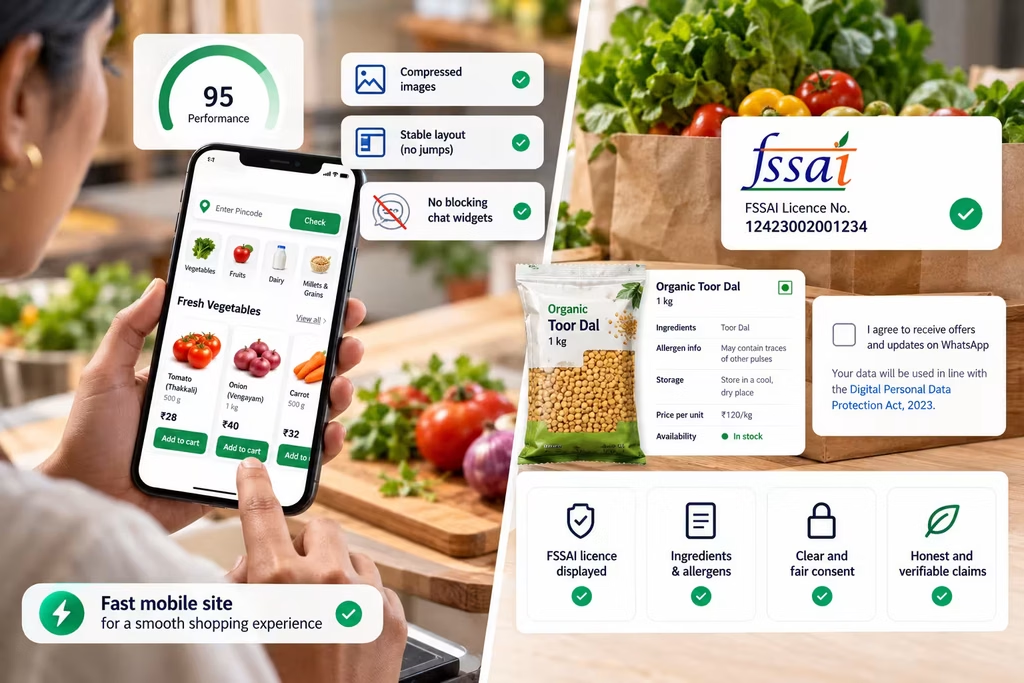
Compress product images, reserve space for images and prices so the layout does not jump, and remove chat widgets and trackers that block the first tap on Add to Cart. Put a pincode check near the top, so a shopper learns whether you deliver before filling a cart.
Strategy 8: Publish the trust details a food seller has to get right
A food seller answers to more rules than most online shops. FSSAI licence display is the first check. Confirm FSSAI’s current rules on where a licence or registration number must appear on your site and product pages. Add ingredient and allergen details to every packaged item.
Section 6 of the Digital Personal Data Protection Act, 2023 requires consent that is free, specific, informed, unconditional and unambiguous, given through a clear affirmative action. A pre-ticked checkout box that enrols the buyer in a WhatsApp offers list does not fit that description, so leave such boxes empty. Words like fresh, organic or farm-direct on a listing are claims you may have to prove, so write only what you can show.
Push Digital has been building brands out of Chennai for more than 25 years. In agency practice, claim wording is often written last on local campaigns, and a freshness promise added the night before launch is hard to substantiate afterwards. Settle the wording, and who can back it up, before the page goes live.
Plan Pongal and Deepavali Pages, Then Measure Orders Instead of Rankings
Festival demand in Tamil Nadu is predictable, which makes it the easiest of the SEO strategies for online grocery stores in India to schedule months ahead.
Strategy 9: Publish festival pages before the demand starts
Pongal needs raw rice, moong dal, jaggery, ghee and cashews in one basket, and Deepavali brings dry fruits, sweet ingredients and gift boxes. Build one page per festival, list the items as a shoppable set, and publish it weeks before the festival so Google has time to index it.
Seasonal grocery SEO pays back because the same address can be refreshed each year and keeps its history. Update last year’s page with new stock, prices and dates instead of deleting it.
Strategy 10: Track orders, not rankings
Rankings are an input and orders are the result. Set up Google Analytics 4 events for view item, add to cart, begin checkout and purchase, then add taps on WhatsApp and call buttons and delivery availability checks.
In Search Console, see which queries bring each area page its impressions, and in your Business Profile, watch the performance figures for calls and directions. A reporting setup that ties search visits to orders should show all four in one monthly view.
What Drives the Cost and Timeline of Grocery Store SEO?
Four things drive grocery store SEO cost: how many products and categories need pages, how many delivery zones need their own page, how often stock and prices change, and how much developer work the platform needs. Competition in your delivery radius sets the timeline.
Published SEO prices in India disagree by several multiples, and published timelines run from weeks to many months. The gap comes from scope: a quote for on-page fixes and a quote that adds new area pages, content and reporting are different products sold under one name.
Owners who type “online grocery store SEO Chennai” into Google get, as of September 2026, mostly agency listings and directories. Ask each agency how many pages it will build or rewrite, what reporting it will send, and what it expects you to supply.
Results tend to show in a set order: impressions in Search Console first, then clicks to area and category pages, then orders. Catalogue-heavy sites also need clean category addresses, product markup and quick pages. A store planning a rebuild should involve web design and development for catalogue-heavy sites before it commissions content.
Conclusion
The SEO strategies for online grocery stores in India that pay back first decide whether a nearby shopper finds you: a complete Business Profile, honest delivery-area pages and tracking that shows orders. Do those before any speed or schema work. Then add catalogue, trust and festival pages in the order the table sets out.
This week, list every locality you deliver to and check that your Business Profile and your website name each one the same way. Check the delivery slots you promise too, since a window the van cannot meet costs more than a missing page. If you want a second opinion on the order, talk to our brand team about your store. Every other strategy here builds on that locality list.
Frequently Asked Questions
What is grocery store SEO?
Grocery store SEO makes your products, delivery areas and store details easy to find on Google and Maps. It covers page structure, Business Profile details, product data and site speed.
Why is local SEO important for online grocery stores?
A store can only serve customers inside its delivery radius, so visibility in that radius decides the order. Local SEO aligns your Business Profile and area pages with what nearby shoppers type.
How long does grocery SEO take to show results?
It depends on how many pages you must build and how crowded your delivery radius is. Expect impressions in Search Console first, then clicks, then orders, with tracking set up beforehand.
How much does SEO cost for an online grocery store in India?
Quotes vary widely because scopes differ, so compare what each one includes. Catalogue size, number of delivery zones and content volume drive the price.
Do I need separate pages for each delivery area?
Yes, for areas you serve regularly, if each page carries facts unique to that area. Slot times, covered streets and local reviews justify a page; a repeated paragraph with a new place name does not.
Should a grocery store hire an SEO agency or do it in-house?
Owners can handle the Business Profile, reviews and festival pages themselves. Schema, faceted navigation and speed fixes usually need a developer, so decide by whether you have one available.