Table of Contents
In today’s digital landscape, having a well-designed website is insufficient if it lacks visibility. To improve website ranking, small businesses must implement strategic optimizations that enhance their online presence. This guide outlines eight essential fixes that can significantly boost search engine performance, ensuring that potential customers can easily find local clinics and services. By following these recommendations, businesses across India can transition from reliance on word-of-mouth referrals to a robust online engagement strategy.
Most search advice is written for US service businesses or global software sites. The conditions here differ. Many visitors arrive on mid-range phones, people search in Tamil, English or a mix of both, and enquiries often come through WhatsApp instead of a contact form. This guide from Push Digital, a Chennai-based 360° branding and digital marketing agency, is built around those conditions, and our guide to local SEO in Chennai goes deeper on the local side.
Key Takeaway: Start with indexing and mobile speed, then give each page one main search intent, then work on titles, local listings, useful content and earned links, checking progress in Google Search Console. This order suits small business owners in Chennai and Tamil Nadu who have a few hours a week and want to improve website ranking without guesswork.
1. Can Google Actually Find and Index Your Pages?

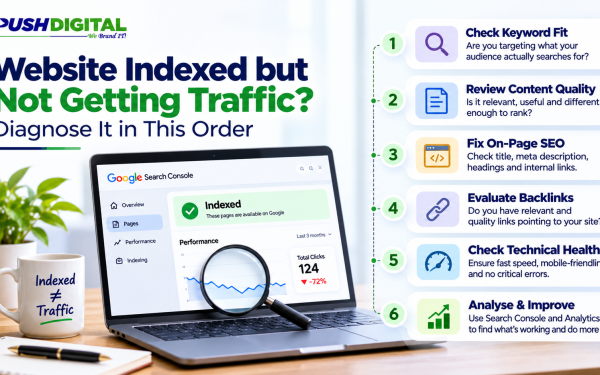
Google Search Console’s Page indexing report lists every URL Google knows about on your site and the reason each one was left out of the index. A page that is not indexed cannot rank for any search, so this report is the first place to look when a page never appears in results.
Open Search Console, go to Indexing, then Pages, and read the table headed “Why pages aren’t indexed”. Three causes are common: pages Google crawled but chose not to index, pages blocked by a robots.txt rule, and pages carrying a noindex tag that was never removed. Each needs a different fix, so read the reason before changing anything.
Say a T. Nagar textile showroom launched its new site straight from a test version, and the developer left a noindex tag on every page. The site looks perfect in a browser while Google has been told to skip all of it. Removing the tag and requesting indexing through the URL Inspection tool allows Google to reconsider the page for indexing, though it does not guarantee inclusion, and the fault can go unnoticed for months if nobody opens Search Console.
If important pages show as discovered but not indexed, check internal links next. A page that no other page links to is hard for Google to prioritise. Submitting an XML sitemap also gives Google a list of the pages you want found.
Start with the pages that bring in enquiries: product categories for a showroom, service pages for a clinic, product and enquiry pages for a manufacturer. Fix this stage before you spend anything else to improve website ranking, because content and links cannot help a page Google has not stored.
2. Slow Mobile Pages Lose Visitors Before Rankings Matter

Consider a Guindy engineering supplier whose homepage carries several-megabyte photos straight from a camera. On an office broadband line it loads fine. On a mid-range phone with a patchy 4G signal, the visitor leaves before the first product appears.
Google measures this experience with three Core Web Vitals: Largest Contentful Paint for loading, Interaction to Next Paint for responsiveness, and Cumulative Layout Shift for visual stability. PageSpeed Insights and the Core Web Vitals report in Search Console both show them, using data from real Chrome users where enough exists. A lab test sits beside that data. The two can disagree, because a lab run has no real person tapping buttons and so cannot measure interaction speed.
Start with the cheapest fixes. Compress images before upload, set a width and height on every image so the layout does not jump, and remove plugins that load on pages where they do nothing. These three fixes remove common causes of slow loading and layout shift on template-built sites.
If the problem sits in the theme, the hosting plan or the way the site was built, another plugin will not solve it. That is a job for web design and development support, because the code itself needs changing.
Test the pages that bring in enquiries on a real phone over mobile data, not only on office Wi-Fi. Tap every button and try the contact form, noting where the page jumps or hesitates.
3. Give Each Page One Main Search Intent to Improve Website Ranking
A homepage can rank for several related searches, but it cannot answer six unrelated ones at once. A common version of this: an Ambattur manufacturer lists casting, machining, fabrication and three other services on one page, then wonders why none of them appears for its own search. Google has no clear signal about which need that page is meant to meet.
Most guides on ways to improve site ranking say “use keywords” and stop there. The more useful rule is one primary search intent per page. Decide the main need each page should satisfy, write for the person who has it, and support it with the related words that person would also use. Related searches, such as “CNC machining Ambattur” and “machining job work Chennai”, can share one page because they ask for the same thing. Unrelated services need their own pages.
Work through it in this order:
- List every service or product you want enquiries for.
- Write the searches a customer would type for each one, in English and, where it applies, in Tamil.
- Group searches that ask for the same thing, and give each group one page.
- Check that no two pages aim at the same primary intent.
Two pages built for the same intent compete with each other, and Google may choose the weaker one or neither. Merge them, or point one at a different need. A simple sheet listing each page’s intent and related searches is enough to catch this. Finding the services that have no page at all is often the first step to improve website ranking for a business whose site was built as a single brochure page.
4. Title Tags Are the Cheapest Fix on Most Websites

The title tag and meta description are the two pieces of text that most shape what a searcher sees before clicking, and they cost nothing to change. Check them early, and read our guide to on-page and off-page SEO for where they fit. Titles like “Home” or a bare company name are common on sites built from templates.
Search results cut long titles to fit the screen width, so put the words people actually search near the front. Google builds the title it shows from several sources, including the title tag, the page’s headings and the text of links pointing at the page, and it can rewrite a title stuffed with repeated keywords. Write one plain, accurate title per page.
Compare two titles for a showroom page. “Home | ABC Textiles” tells a searcher nothing. “Silk Sarees in T. Nagar, Chennai | ABC Textiles” names the product, the place and the shop in a form a person would read aloud. (ABC Textiles is a made-up name.)
Google may use your meta description in search results, but it can also generate a snippet from the page content. Write each one by hand, give one concrete reason to click, and never repeat the same text on two pages. A site crawler such as Screaming Frog lists missing and duplicate titles and descriptions in one pass, so you can audit every page in a single sitting.
To test the effect, open the Performance report in Search Console and find queries where a page already appears but sits just below the first page. Rewrite the title for one of those pages, note the date, and compare clicks and impressions several weeks later. Results vary with the competition, and a new title cannot move a page that has nothing useful on it.
5. What Chennai and Tamil Nadu Searchers Do That Generic Advice Ignores
Think of a Velachery tuition centre that has a good services page but a Google Business Profile with the wrong category and a phone number that differs from the one on its website. A parent searching on a phone sees a listing that does not quite match the search and calls a competitor instead.
Google’s local ranking guidance for Business Profiles states that local results are ranked mainly on relevance, distance and prominence, and that there is no way to request or pay for a better local ranking. Reviews count towards prominence, along with links, articles and directory entries about the business. Google Business Profile optimisation therefore starts with plain accuracy: the right category, the right address, current hours and one phone number used everywhere.
Local search habits add three details that generic guides skip:
- Language: People search in Tamil, in English and in Tanglish, which is Tamil typed in English letters. A page written only in English gives Google little to match against a Tamil query. Check the Performance report in Search Console for Tamil or Tanglish queries before deciding which pages to translate.
- WhatsApp: Many customers prefer to message a business on WhatsApp, so put a click-to-chat button beside the phone number and record clicks on it as an event in Google Analytics 4. That measures click-to-chat activity, not confirmed enquiries, so log separately which chats actually began and which became qualified leads.
- Seasons: Searches for clothing, jewellery, sweets and gifts tend to rise before Pongal and Deepavali, so refresh those pages several weeks ahead.
Keep the name, address and phone number identical on the website, on the Business Profile and on directories such as Justdial and Sulekha, so every source describes the same business. Then ask recent customers for reviews, since review count and score feed into local ranking. This is local SEO for a Chennai small business at its simplest, and it can run alongside everything else in this guide.
6. How Do You Build Content Google Trusts on a Small Budget?

A small business earns Google’s trust by covering one topic thoroughly, starting with the questions customers ask before they buy and the ones they ask after, instead of publishing scattered posts. Each page should answer a real question better than the results already showing, with named sources and detail only your business has.
Search marketers call this topical authority: a site that covers a subject from several angles gives Google more reasons to treat it as a source for that subject. A small business can improve website ranking on a modest budget by writing fewer pages and finishing each one properly. Begin with the questions your staff answer every week on the phone and on WhatsApp, because each repeated question is a page waiting to be written.
Give every page something a competitor cannot copy: your own process, the factors that move your price, photographs of your own work, a mistake you see customers make before they call. Name the platform, the rule or the figure behind each claim, and link to the source.
Google’s guidance for site owners says no special optimisation is needed to appear in AI Overviews and AI Mode, and that normal SEO practice still applies. A page that answers the question in its first sentences suits readers and AI summaries equally.
Keep old pages current, and review every important page twice a year.
Some of this work goes faster with outside help. Push Digital has been building brands out of Chennai for more than 25 years. Over that time customers have moved from hoardings and print to Google, Instagram and WhatsApp. Good SEO and digital marketing support covers the writing, the measurement and the monthly review, and goes beyond a one-off audit.
7. Links Worth Earning Come From Places Your Customers Already Trust
Our view is that one link from a body your customers already recognise is worth more than a long list of directory entries. Quality backlinks work as votes of confidence, and a link from a relevant source says more than one from a site with no connection to your trade.
Links also follow from being useful. A practical guide that a trade association shares with its members, or a supplier points to from a product page, earns a link without anyone asking for one. Pitch it to the people who would genuinely use it, and keep the request short.
Realistic sources for a small business include:
- A supplier or manufacturer whose products you sell, listing you as a stockist or dealer
- A trade or business association you already belong to
- A local news site covering an opening, an event or a community project
- A customer who agrees to a case study that names your business
Google’s spam policies define link spam as creating links to or from a site primarily to manipulate search rankings, and sites that break the policies may rank lower or not appear at all. The examples listed include excessive link exchanges, partner pages built only for cross-linking, and sending someone a product in exchange for a post that carries a link.
An offer of bulk links for a monthly fee fits that pattern, however it is described. Ask where each link will appear and whether a real reader would ever see it there. If the answer is no, decline.
8. Track Rankings, Traffic and Enquiries Every Month
A fix only counts if you can see its effect, so set up three views before you change anything: rankings, traffic and enquiries. Search Console’s Performance report gives clicks, impressions and average position for each page and search. Google Analytics 4 shows how many visitors arrived from search and what they did next. Enquiries come from your own records: calls, forms and WhatsApp chats. Keep three counts apart: button clicks, conversations that actually started, and qualified leads. A click is only a sign of interest, so judge results by the last two.
Export a baseline first, then review the same three views once a month. Look at direction over several months, because day-to-day positions move for reasons nobody outside Google can see. Since August 31, 2026, Search Console also offers a generative AI performance report for all sites worldwide. It shows impressions in AI Overviews and AI Mode, though not clicks, and it may not appear for sites with too few impressions.
How long does it take to improve website ranking? No single timeline holds, which is why published estimates contradict one another. The time depends on three things: the site’s starting point, such as an indexing fault or few links; how competitive the search is; and how much of the work is a one-time fix rather than ongoing content.
Fixes to indexing, titles and page speed are one-time changes that Google can pick up when it next crawls the page. Content and links run on a slower clock, because pages must be written, found and trusted. A business with an indexing fault and no local listing can see movement sooner than one that already ranks and wants to overtake a larger competitor.
The order matters more than the pace. A business that tries to build links before fixing indexing is adding weight to pages Google has not stored.
Push Digital’s Ranking Fix Order puts the eight fixes in that sequence, with the effort each takes, who usually handles it and where to check that it worked. It is a recommended method, built from the reasoning in this guide, and it makes no claim about measured results.
| Order | Fix | Effort | Who handles it | Where to check |
|---|---|---|---|---|
| 1 | Confirm pages are indexed | Low | Owner or developer | Page indexing report |
| 2 | Fix mobile speed and layout shift | Medium | Developer | PageSpeed Insights |
| 3 | Map one main search intent to each page | Low | Owner and marketer | Intent-to-page sheet |
| 4 | Rewrite titles and descriptions | Low | Marketer | Performance report |
| 5 | Complete Business Profile and listings | Low | Owner | Business Profile and Search Console |
| 6 | Publish and update helpful pages | Medium | Marketer | Impressions and clicks |
| 7 | Earn links from relevant sites | High | Owner and marketer | Links report |
| 8 | Track rankings, traffic and enquiries monthly | Low | Marketer | Performance report, GA4 and enquiry log |
Nobody outside Google controls the order of results, so a promise of a guaranteed first position should raise a question. ASCI’s Code for Self-Regulation says any advertising claim that rests on checkable fact must be capable of substantiation, and advertisers and agencies must produce that evidence when asked. An agency advertisement that guarantees a ranking would struggle to meet that test. Ask any provider what they will report each month and what they will do if the numbers do not move.
Conclusion
To improve website ranking, the order of the work matters more than the amount of it. Fix whatever stops Google finding your pages, then give each page one main search intent, and let titles, local listings, useful content and earned links follow in that order.
This week, open Search Console, read the Page indexing report and list the five pages that matter most to your business. Check that Google has indexed each one, and write the date next to it so your monthly review has a baseline. If the fixes need a developer or a writer, talk to our brand team about a scope discussion. The indexing check itself costs nothing.
Frequently Asked Questions
How long does it take to improve Google rankings?
It depends on the starting point and the competition, so no honest provider can promise a date. Indexing and title fixes can show up sooner than content and link work.
Does Google Search Console help improve website ranking?
Search Console does not raise rankings by itself. It shows which pages are indexed, which searches bring impressions and where problems sit, and the gain comes from acting on that.
What is the fastest way to rank higher on Google?
Fix indexing first, then rewrite titles on pages that already appear near the first page. These changes need no new content, so they are the quickest to try.
Do Indian websites need different SEO from international ones?
The basics are the same, but local detail changes the work. Mobile speed, Tamil and English queries, WhatsApp enquiries and local listings deserve more attention here than in Western guides.
Are backlinks still needed to rank?
For competitive searches, relevant links help, and a local business can start with listings and a complete Business Profile. Avoid link exchanges and product-for-link deals, which Google’s spam policies name.
Does ranking first matter when AI Overviews answer the question?
Yes, since Google says normal SEO fundamentals still apply to AI search. Search Console’s generative AI report, global since August 31, 2026, shows impressions in AI Overviews and AI Mode.