

Table of Contents
Ad spend gets cut for a month, a quarter, sometimes for good. The moment it stops, so does the phone. That single fact tells you what paid traffic actually is: rented visibility. Increase organic traffic without paid ads and the visitors you earn keep arriving long after the campaign that brought the first ones has been forgotten.
This matters most to a business that has just paused its Google or Meta budget and needs a real plan, not a list of forty generic tips copied from the same five agency blogs. The plan below is sequenced, and it is written with Chennai and Tamil Nadu businesses in mind, since most guides on this topic are written for nobody in particular.
Key Takeaway: Organic traffic grows by fixing pages you already have before writing new ones, publishing content built around real local search behaviour, and owning a channel Google cannot take away from you. It costs time and consistency, not media spend, and it suits a business that can commit a few hours a week for several months rather than one that needs visitors by Friday.
How Long Does It Take to Increase Organic Traffic Without Paid Ads?
Search Console usually shows movement within two to four weeks for a title or intent fix on a page that already ranks somewhere on Google. A genuinely new page, on a site with little existing authority, tends to take longer, often several months before it earns a stable position. The honest answer depends on what stage the work starts from, not a single number that applies to every site.
Agency blogs on this topic tend to quote one figure as though it were universal, usually somewhere between three and six months. In practice the range in circulation runs from a couple of weeks for a quick fix to the better part of a year for a brand new domain in a competitive category. Sources disagree because they measure different starting points. An established site correcting a weak page is not the same task as a business publishing its first ever piece of content. That difference is worth knowing before you commit a budget of hours, because it changes what a realistic first checkpoint looks like.
| Factor | Organic | Paid |
|---|---|---|
| Cost while running | Time and consistency | Money per click or impression |
| What happens when spend stops | Traffic usually holds or keeps growing | Traffic stops within days |
| Where the effort sits | Content, technical fixes, local listings | Campaign management, creative, bidding |
Push Digital has been building brands out of Chennai for more than 25 years. The pattern that repeats across that time is simple: businesses that treat organic search as a six-month commitment see it compound. Businesses that check after three weeks and give up never find out what the second month would have looked like.
Fix What You Already Have Before Writing Anything New

A page that already gets found for a search term but rarely gets clicked is usually the fastest organic win available, faster than any new article. That gap between being shown and being chosen is a title and description problem, not a content problem, and it is worth fixing before anything else on this list.
Rewrite Titles That Earn Impressions but No Clicks
Open Search Console, sort by impressions, and look for pages with plenty of visibility and a thin click-through rate. The page is showing up for the right search. The title or description just is not convincing anyone to click it. Rewrite both to match what the searcher actually typed and to say plainly what the page delivers.
Refresh an Old Post Before Drafting a New One
A page that used to attract visitors and has quietly declined is often a better use of an afternoon than a brand new article. Add a section the original missed, update anything that has dated, tighten the parts that ramble, and change the publish date only once the content genuinely changed. A refreshed page keeps its existing links and history, which a new page has to build from nothing.
Link Every New Page Back to the Old Ones
Every time something new goes live, go back to two or three older pages and add a link to it where the topic genuinely fits. This is the step almost every small business site skips, and it is one of the few organic levers that costs nothing but attention.
What Should a Chennai Business Publish First?
Start with the searches your actual customers already run, not the broad industry term everyone competes for. A Purasawalkam textile retailer competing for “clothing store” against national chains will lose. The same retailer targeting “silk saree shop near T. Nagar” or a specific product line has a real shot at page one within a manageable timeframe.
Local relevance is the clearest gap in most generic advice on this topic, because most of it is written for a market where a Google Business Profile and an accurate address are assumed, not explained. Google’s Business Profile guidelines require an accurate address or a clearly defined service area, and they permit only one profile per physical location. They also expect the business name on the profile to match what is actually on the signage outside. A profile with a mismatched name or a vague service area is exactly the kind of small error that keeps a genuinely good local business off the map pack.
A clinic on OMR with the wrong phone number on its listing loses every call from a patient who tries that number once and gives up. Fixing that single field is worth more, in the first month, than any blog post the clinic could publish.
Local search habits differ from the generic advice too. Tamil and Tanglish phrasing shows up in real queries, and WhatsApp is often where the actual enquiry happens after the Google search. Festival timing around Pongal, Deepavali, and wedding season also shifts what people search for by weeks, and content or listings that account for that timing outperform content that ignores it.
Push Digital’s First-Move Matrix for Organic Traffic below is the order most small and mid-sized businesses should work in, based on what typically produces the fastest visible signal in Search Console.
| Business type | First move | Where traffic comes from | First metric to watch |
|---|---|---|---|
| Local service business (clinic, salon) | Complete and correct the Google Business Profile | Map pack, local search | Profile calls and direction requests |
| Showroom retailer | Product and category pages with local terms | Search, map pack | Impressions on product-page queries |
| Manufacturer or B2B supplier | Fix titles on existing product pages | Search | Click-through rate on ranked pages |
| Online-first D2C brand | Long-tail content around specific use cases | Search | New queries appearing in Search Console |
| Professional services firm | FAQ and process content answering real client questions | Search, AI answer engines | Impressions on question-form queries |
Own an Audience Google Cannot Take Away
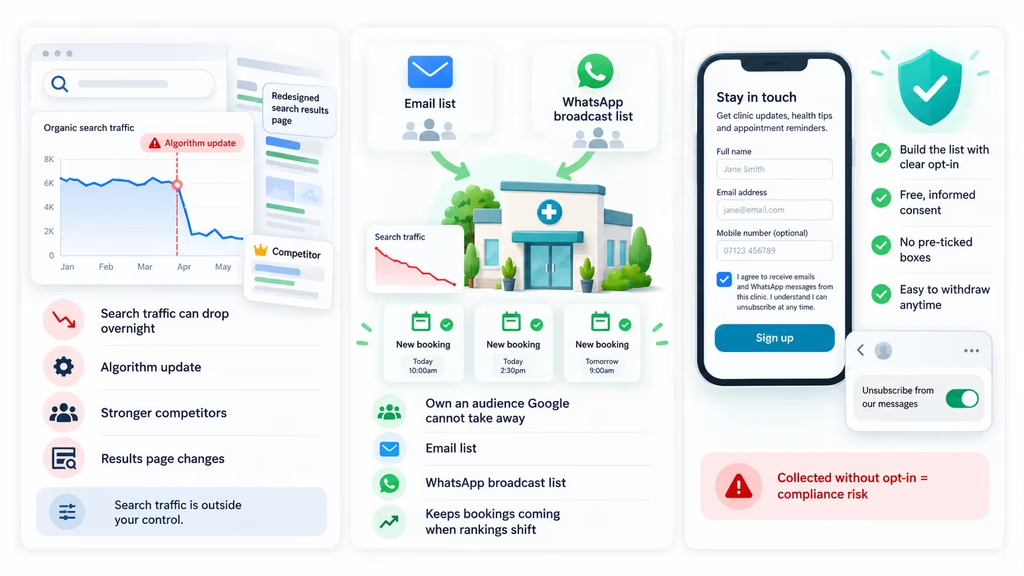
A search algorithm update, a competitor with more resources, or a redesigned results page can all take away search traffic overnight, and none of those events are under your control. An email list or a WhatsApp broadcast list belongs to the business, not to a platform, which is why it is the one channel that keeps performing when search results shift.
Picture a clinic whose organic bookings drop after an algorithm change nobody at the practice caused or could predict. The email list built from past patients and the WhatsApp broadcast list built from enquiries keep generating bookings that week regardless, because neither depends on where the clinic ranks that morning.
Building that list carries a legal obligation most guides on this topic skip entirely. India’s Digital Personal Data Protection Act, 2023 requires that consent for processing personal data be free, specific, informed, unconditional, and unambiguous, given through a clear affirmative action rather than a pre-ticked box or silence. The same Act gives the person who gave consent the right to withdraw it at any time, with the process for withdrawing made just as easy as the process for giving it was. A WhatsApp broadcast list built from numbers collected without that clear opt-in is a compliance risk sitting quietly inside what looks like a marketing win.
Track Four Numbers Every Month, Not Twenty
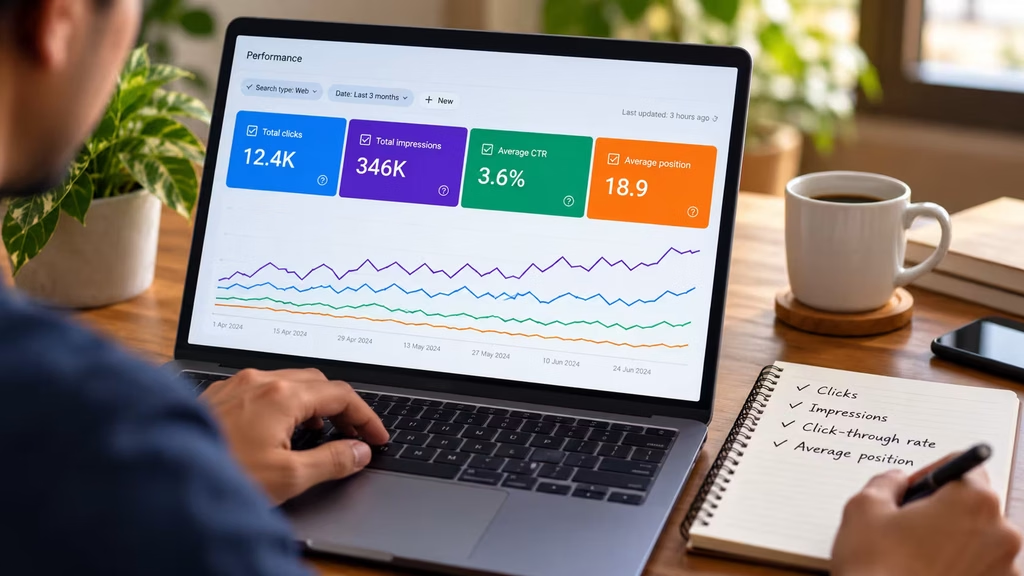
Search Console’s Performance report gives four numbers that matter: clicks, impressions, click-through rate, and average position. Clicks and impressions show whether visibility is growing. Click-through rate, the click count divided by the impression count, shows whether the title and description are convincing anyone. Average position shows where the topmost ranking page from your site typically sits in results. Checking these four monthly beats chasing a dashboard full of vanity metrics that say nothing about whether the work is paying off.
These four numbers are also the clearest evidence of whether the work to increase organic traffic without paid ads is actually paying off. A page with high impressions and a low click-through rate needs a better title, not more content. A page with almost no impressions needs to be checked for whether it is actually indexed before anything else is tried. Reading the four numbers in that order, coverage first, then response, tells you which fix to make next instead of guessing.
Whether AI tools now cite a business is harder to check directly, since most cannot be queried from inside a reporting dashboard. The practical substitute is asking the same question a customer might type into ChatGPT or Perplexity and noting which businesses come up in the answer. A business that never appears in that answer, month after month, usually has the same underlying problem as a page with low impressions. There is not enough specific, citable detail on the page for anything to pull from.
Conclusion
You can increase organic traffic without paid ads by starting with what already exists on your site, not with a blank page. Open Search Console this week, find the page with the highest impressions and the lowest click-through rate, and rewrite its title to match what people actually searched for. That single fix, repeated across a handful of pages, usually moves faster than any new article would.
Push Digital’s digital marketing team works through exactly this sequence with Chennai businesses every month: fix what exists, publish what local search actually asks for, and build the list a platform cannot take away. If your website needs the technical groundwork sorted before any of this pays off, our website design and development work covers that first. Talk to our team if you want a second set of eyes on where your site is losing clicks right now.
Frequently Asked Questions
How do you increase organic traffic without paid ads?
Fix existing pages with weak click-through rates first, then publish content around real local search terms, and build an email or WhatsApp list. Track Search Console monthly to see which fix is working.
How long does it take to get organic traffic?
Small fixes to existing pages can show movement within weeks. New pages on a site with little history usually take longer, often several months before results settle.
What is the fastest free way to increase website traffic?
Rewriting titles and descriptions on pages that already rank but rarely get clicked is usually fastest. It needs no new content, only a Search Console check and a rewrite.
Can you increase organic traffic without backlinks?
Yes, for a period. Fixing on-page issues and local listings drives early gains without any backlinks. Sustained growth in competitive categories eventually needs some, though not immediately.
Should I update old posts or publish new ones?
Update first if a post used to perform and has declined. It keeps its existing links and history, which a brand new page has to build from nothing.
How often should a small business publish?
Consistency matters more than volume. One well-researched piece a month, published on a predictable schedule, outperforms a burst of posts followed by months of silence.