Table of Contents
A campaign can look busy without winning customers. Impressions rise and the lead report grows. But which activity brought a qualified buyer?
That question frames digital marketing trends 2027. AI is changing search, ads and production. Customers expect clear videos and quick responses. Teams still need to separate established changes from predictions and decide what their budgets can test.
Key Takeaway: The strongest marketing priorities for 2027 combine AI-assisted execution with sound SEO, first-party customer data, relevant video, regional communication and sales-focused measurement. For Indian businesses, the practical move is to audit existing channels, choose a few changes that fit customer behaviour, and test them against qualified enquiries or revenue rather than platform activity alone.
Digital Marketing Trends 2027: What Is Already Changing?
The biggest digital marketing changes heading into 2027 involve AI-assisted search, automated advertising, customer data, video discovery, conversational selling and more disciplined measurement. Google already offers generative search experiences and AI-enabled campaign features. The pace of adoption in 2027 remains a forecast, so marketers should separate confirmed capabilities from expected business impact.
Pew Research Center studied US browsing activity in March 2025. People clicked traditional search results in 8% of visits with an AI summary, versus 15% without one. The Pew Research Center analysis describes that sample, not all Indian searchers. Still, it warns against assuming visibility equals traffic.
| Trend | Already visible by 2026 | What to assess for 2027 |
|---|---|---|
| AI workflows | Assisted research and production | Review quality and time saved |
| SEO, AEO and GEO | AI search experiences | Qualified search visibility |
| AI advertising | Automated targeting and creative | Lead quality and conversion value |
| Short video | Reels and Shorts discovery | Retention and enquiries |
| Creator credibility | Expert and customer-led content | Trust and buyer response |
| Regional marketing | Language-specific creative | Local lead quality |
| First-party data | CRM and consent processes | Data accuracy and permissions |
| WhatsApp commerce | Chat-based sales paths | Qualified conversations |
| Agentic shopping | Emerging AI-assisted comparison | Product information readiness |
| Revenue measurement | Lead and sales event tracking | Cost per qualified outcome |
The query “future of digital marketing 2027” deserves testable decisions, not predictions about a winning platform.
What Is Expected to Accelerate in 2027?
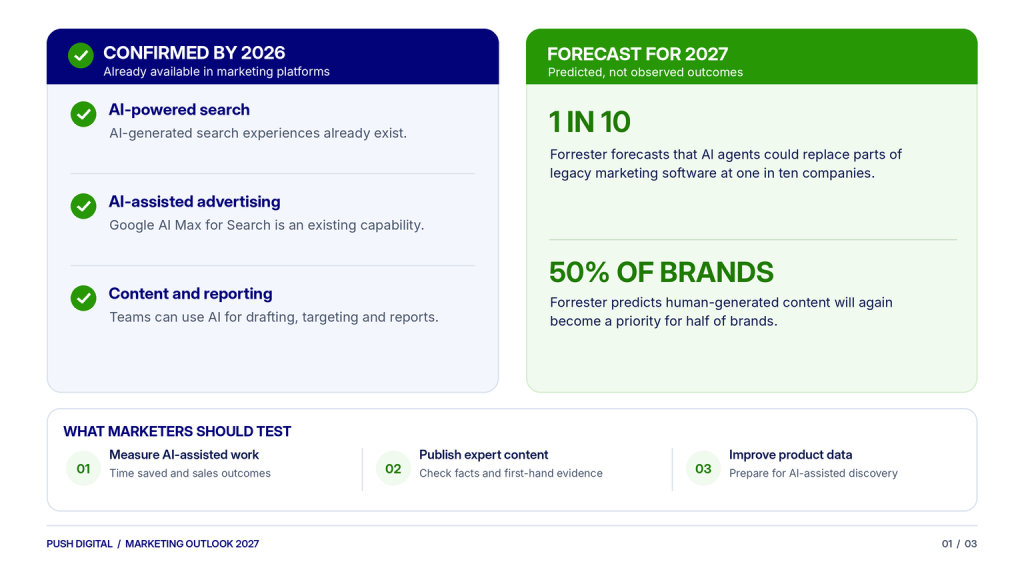
The likely 2027 acceleration concerns how marketers evaluate and integrate AI, rather than the arrival of AI marketing itself. Google already offers AI-powered search experiences and AI Max for Search campaigns. Teams also use AI for content production, targeting and reporting. These are confirmed 2026 capabilities, not predicted launches.
Predicted for 2027: Forrester expects AI agents to replace parts of legacy marketing software at one in ten companies. It also forecasts human-generated content becoming a priority again for 50% of brands. Both figures are forecasts, not observed 2027 results.
What marketers should do: Test AI-assisted workflows against actual time savings and sales outcomes, publish verifiable expert content, and prepare accurate product information for AI-assisted discovery. Invest further only when the results justify the cost.
AI Is Rewriting Search, Advertising and Everyday Marketing Workflows
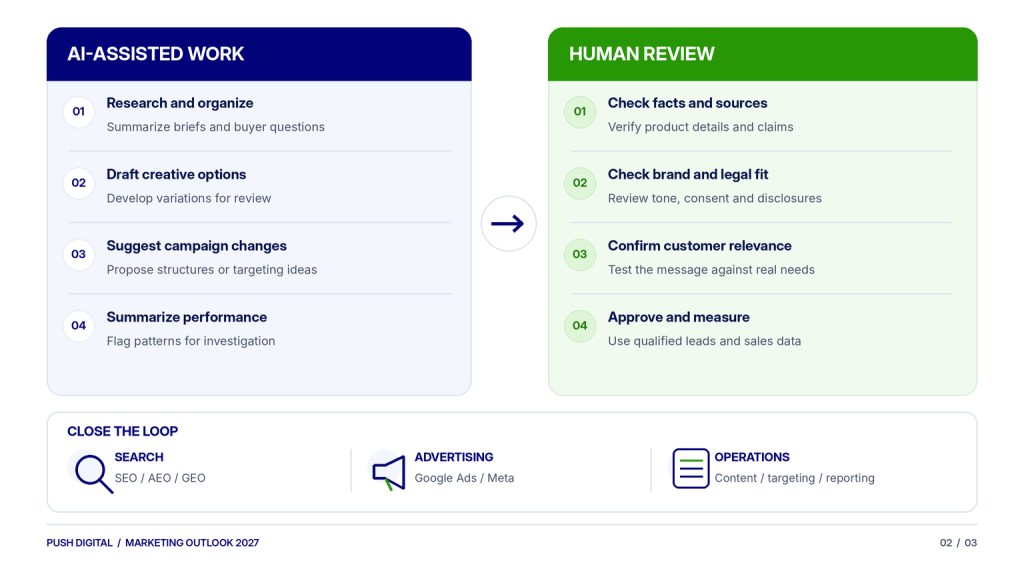
AI lets small teams produce more, but quality still depends on reliable inputs, review and clear goals.
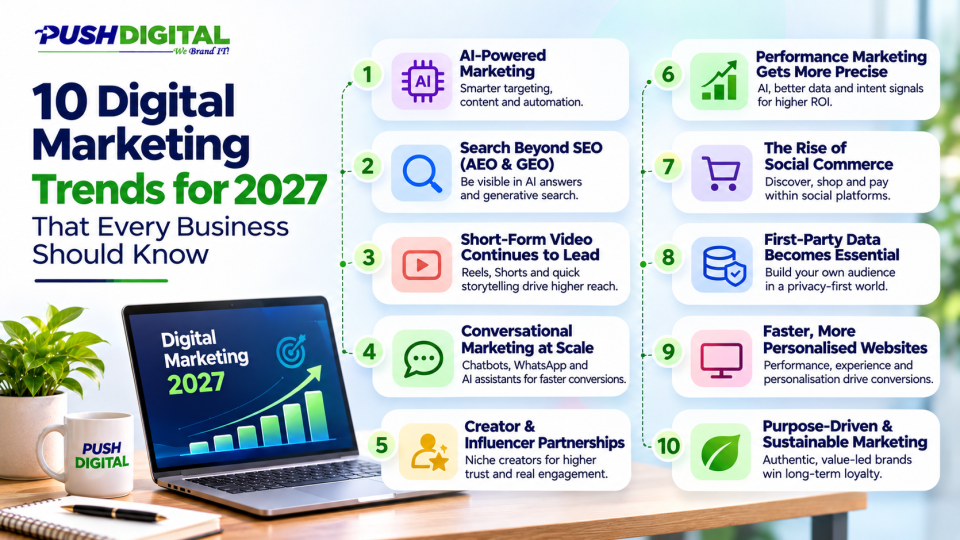
Trend 1: AI-Powered Marketing and Automation
AI tools can organize research, suggest questions and draft variations. They are less dependable when claims involve live pricing, law, product details or buyer objections.
Give AI the first pass and a person the final decision. Review sources, brand consistency and campaign goals. AI powered digital marketing works better when changes are recorded.
For marketing automation trends, track time saved and correction work. Review prices, product claims, names and calls to action before publication.
Trend 2: SEO, AEO and GEO
Search engine optimization (SEO) helps people find useful pages. Answer engine optimization (AEO) offers direct answers. Generative engine optimization (GEO) considers how AI systems represent a business.
These practices overlap. In May 2026, Google confirmed that SEO remains the base for its AI search features. Its AI search optimization guide calls for original content, sound site structure and trustworthy information. Special GEO tricks cannot guarantee placement.
For generative engine optimization, answer real buying questions and verify every claim. Keep contact details consistent. Use Search Console to assess search visibility and connect traffic to enquiries where possible. Prioritize clear service-scope pages over repetitive definitions, and test the enquiry path.
Trend 3: AI-Driven Paid Advertising
Google AI Max can expand Search matching, adapt ad text and choose relevant landing URLs. Meta also automates parts of campaign delivery. Marketers must set limits, review creative and measure outcomes.
Consider a hypothetical Chennai web development campaign. Fifty cheap forms may be worth less than ten buyers with real budgets. Define qualification rules first; then feed verified lead outcomes into reporting where supported.
AI marketing trends 2027 matter only when conversion signals reflect buyer quality. Watch cost per qualified lead.
Video, Creator Proof and Regional Languages Shape Brand Discovery
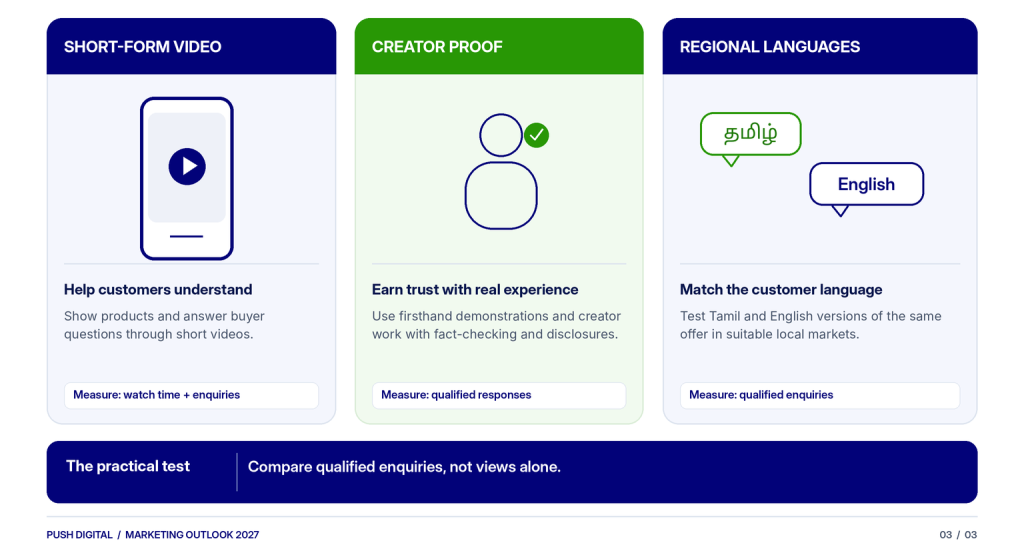
Discovery happens across search, social feeds and recommendations. Content must show the offer clearly and match customer language. That is one practical test for digital marketing trends 2027.
Trend 4: Short-Form Video Marketing
Instagram Reels and YouTube Shorts can show products and answer objections. A furniture retailer could show material details; a clinic could explain appointments without unsupported claims.
Build videos around a customer question and visible proof. Compare watch time with enquiries. Searchers exploring social media marketing trends 2027 need results, not just format ideas. Test a demonstration against a customer-question video using the same offer; compare qualified leads, not just views.
Trend 5: Human-Led Content and Creator Partnerships
As AI content grows, clear first-hand explanations have value. A technician demonstrating a repair or a founder discussing materials can answer questions a generic script misses.
Creator briefs should separate opinions from product claims. Check facts, usage rights and required disclosures. Track qualified responses where possible; follower totals alone say little about sales. Agree on footage reuse, channels and usage duration before publication.
Trend 6: Regional-Language and Hyperlocal Marketing
Language should follow the customer. A hypothetical Coimbatore retailer could test Tamil and English videos with the same offer, then compare qualified enquiries.
A Tamil ad promising a demonstration needs a landing page that fulfils that promise.
Push Digital has been building brands out of Chennai for more than 25 years. Before creating regional ads, define the audience, area, buying question and response language. The branding and creative services at Push Digital provide relevant context.
What Will Privacy-First Data and WhatsApp Change for Lead Generation?
Privacy-first marketing makes the collection and use of customer information more deliberate. First-party records from forms, purchases and customer conversations can help businesses understand demand, provided they handle permissions and data securely. WhatsApp can shorten the route from interest to enquiry, but sales teams still need qualification, response standards and a reliable way to record outcomes.
Trend 7: First-Party Data and Privacy-First Marketing
First party data marketing uses direct enquiries, orders and preferences. Records must distinguish visitors from buyers and respect permitted uses.
India’s Digital Personal Data Protection Rules, 2025 have staged commencement. Under the Gazette notification dated 13 November 2025, some rules took effect on publication, Rule 4 takes effect one year after publication, and Rules 3, 5–16, 22 and 23 follow after eighteen months. Review the official DPDP Rules notification for the applicable requirements and dates; this is not a claim that every provision is already in force.
Audit lead forms, consent notices, access rights and retention practices with a privacy specialist. Assign an owner to review live forms whenever consent wording changes.
Trend 8: WhatsApp and Conversational Commerce
A click-to-message ad starts a chat, not a qualified lead. Ask only for useful details such as service, location and timing. Offer a human handoff.
Count appointments and sales, not just message starts. One person sending three messages is still one buyer. Track response time and qualified conversations.
AI Shopping and Revenue Metrics Redefine Marketing Performance
AI may help buyers compare offers before a website visit. Accurate product details and sales records support both discovery and measurement.
Trend 9: Agentic AI and AI-Assisted Shopping
AI shopping assistants can compare prices and specifications. Google describes early agentic tools, but 2027 buying patterns remain uncertain. Consider a buyer comparing two mixers. One seller lists wattage, capacity, warranty and delivery clearly; the other provides only a product name and picture. The first gives both people and software more facts for a fair comparison.
A Shopify retailer can maintain accurate titles, sizes, prices, stock and policies. Avoid pages written only for AI crawlers. Clear product data serves buyers too.
Service providers need clear scope and contact details. The Push Digital portfolio shows work examples, without implying those projects used AI shopping.
Trend 10: Revenue-Focused Marketing Measurement
A lead count without sales readiness can mislead. Google Analytics 4 recommends generate_lead, qualify_lead and close_convert_lead events. They distinguish enquiries, qualified prospects and customers.
Suppose thirty forms produce six qualified leads. Cost per form and cost per qualified lead tell different stories. Neither alone measures profit.
Track qualified lead rate, acquisition cost and revenue where possible. Record gaps in attribution and offline sales. Each report should inform a decision. Use one lead identifier across sales updates to avoid counting returning prospects twice.
Which Trends Should Indian Marketers Prioritize First?
Indian marketers should prioritize trends that match customer behaviour and can be measured with their present resources. For a small business, reliable lead tracking and a clear local website often come before complex agentic commerce experiments. A simple readiness score can reveal whether the next investment belongs in content, data quality, advertising or sales follow-up.
Push Digital, a Chennai-based 360° branding and digital marketing agency, recommends the Push Digital’s 2027 Marketing Readiness Scorecard. Score five factors from 0 to 2 for a total of 10. This is a suggested planning tool, not a validated benchmark.
| Readiness factor | Score 0 | Score 1 | Score 2 |
|---|---|---|---|
| Customer relevance | No clear demand | Some evidence | Repeated buyer need |
| First-party data | Unreliable | Partial records | Usable records |
| Budget readiness | No test budget | Limited test | Funded test |
| Team capacity | No owner | Shared owner | Assigned owner |
| Measurement capability | No outcome tracking | Partial tracking | Qualified outcome tracked |
A score of 8–10 supports testing; 4–7 suggests fixing gaps first; below 4 favours preparation. These are suggested bands, not guarantees.
For searches such as “digital marketing trends 2027 India”, local application is the point. Build a digital marketing strategy for 2027 around two priorities and a baseline. The digital marketing services offered by Push Digital can connect campaign and creative planning.
Conclusion
Digital marketing trends 2027 should change a team’s operating plan, not simply its vocabulary. AI can speed production and widen search or advertising options. Video and regional content can explain products more clearly. First-party records and conversational follow-up can connect interest to sales. Each only earns budget when it solves a visible customer or operational problem.
This week, choose one active campaign and map the route from first impression to confirmed sale. Note where tracking stops, where a customer waits for a response, and which information the sales team still needs. Then pick two trends that address those gaps and give each a measurable test.
Marketers do not need to predict every feature a platform will release in 2027. They need evidence, a repeatable process and the discipline to stop activities that generate activity without a useful result. If that process needs a coordinated creative and campaign plan, discuss the scope through Push Digital’s contact page. The conversation should begin with the business outcome you need to measure.
Frequently Asked Questions
What are the biggest digital marketing trends for 2027?
AI-assisted workflows, AI search, automated advertising, first-party data, short video and revenue measurement are the major areas to monitor. Their value depends on customer fit and execution.
Will AI replace digital marketers in 2027?
AI can reduce repetitive work, but it does not remove responsibility for strategy, claims or customer understanding. Teams still need human review, commercial judgement and clear accountability.
Is SEO still relevant with AI-powered search?
Yes. Google says established SEO practices remain relevant to its generative search features. Accessible pages, original answers and trustworthy business information still support search discoverability.
How should small businesses prepare their marketing budgets for 2027?
Start by protecting channels that already produce qualified outcomes, then reserve a controlled amount for experiments. Document each test’s baseline, owner, success measure and review date.
Which digital marketing KPIs should businesses track in 2027?
Track qualified leads, cost per qualified lead, booked consultations and sales revenue where records allow. Impressions and clicks remain useful diagnostics, but they cannot prove business growth.