

Table of Contents
A Chennai boutique that redesigned its website last year still shows up on page four for its own product category. Its Google reviews, on the other hand, are strong: dozens of five-star ratings and steady mentions on two local directories. That split, a site that works but barely ranks, next to a reputation search engine that barely credits, is the whole On-Page vs. Off-Page SEO question in one business.
Most owners treat the two as a single checkbox. They are not. One sits entirely inside a business’s control. The other depends on what other websites, reviewers, and platforms say about it. Mixing them up is why marketing budgets get spent on the wrong fix first and why a well-reviewed business can still lose the local pack to a competitor with a faster, cleaner site.
Key Takeaway: On-page vs. off-page SEO comes down to control. On-page covers content, structure, and load speed; off-page covers the backlinks, reviews, and mentions that build authority elsewhere. Most Chennai SMBs should close on-page gaps first, then layer off-page work once the site is worth linking to.
What On-Page SEO Actually Controls, and What It Doesn’t
On-page SEO covers everything a business can edit directly on its own website: titles, headings, content, internal links, and page speed. It does not cover backlinks, reviews, or mentions on other sites, which fall under off-page SEO instead. The two work on different levers, so fixing one rarely moves the other.
Google’s Core Web Vitals guidance measures three of the largest on-page signals: how fast the biggest visible element loads, how quickly the page responds to interaction, and how much the layout shifts while loading. A site that fails these checks can have the best copy in Chennai and still lose ground to a faster, plainer competitor page. That is the practical weight on-page SEO carries: it decides whether Google can read and trust the page at all.
| Factor | On-Page SEO | Off-Page SEO |
|---|---|---|
| What it controls | Content, structure, page speed, metadata | Backlinks, reviews, mentions, citations |
| Who executes it | The business or its web team | Outreach, PR, review requests, listings |
| Typical timeframe | Weeks | Months |
| Typical Chennai SMB cost driver | Content rewrite, technical fixes | Link outreach, directory listings, reputation management |
A business fixing on-page issues is working with a fixed, known set of pages. A business building off-page authority is working with an open, slower-moving set of relationships. That difference alone explains most of the confusion between the two.
The terminology adds to the confusion. Some marketers phrase it as on-site SEO versus off-site work instead, describing exactly the same split: what happens on the domain a business owns and what happens everywhere else, whatever order the words land in.
What business owners are usually asking is narrower than the search phrase suggests, which half explains why their site isn’t ranking despite looking fine. The honest answer is rarely one alone. It is nearly always a combination, weighted differently by how competitive the category is.
The Foundation: How Google Weighs the Two Together

Google never ranks on-page or off-page signals alone; it weighs both together. On-page tells the algorithm what a page is about. Off-page tells it how much to trust that page against competitors. A flawless page with no outside validation underperforms, and so does a weak page propped up by strong backlinks.
Structured data is the clearest example of where the two systems meet. Marking up a business’s address, hours, and review count with schema helps Google understand the page on-page, while the reviews behind that markup are an off-page signal earned through customer behavior. Push Digital’s digital marketing team treats structured data as the handoff point: get the markup right, and every review the business earns afterward compounds instead of sitting unread by the crawler.
A site with a Google Search Console account showing clean indexing, no crawl errors, and fast Core Web Vitals is in a strong position to benefit from off-page work. Without that foundation, backlinks and mentions are pointing traffic at a page that cannot convert it once it arrives. This is on-page vs. off-page SEO in its most literal sense: two systems that only pay off together, not separately.
Technical SEO sits underneath both categories rather than beside them. Crawlability, canonical tags, and site architecture affect how well on-page content gets indexed and how efficiently off-page authority flows through internal links once it reaches the site. A genuinely complete picture adds this third layer to the usual two: technical SEO is the plumbing that decides whether either of the other two can do its job at all.
A page with excellent content and strong backlinks still underperforms if a broken canonical tag tells Google to ignore it or a slow server delays crawling. Technical fixes are usually cheaper than content rewrites or off-page campaigns, which is why they belong at the start of any audit.
Where This Plays Out for a Chennai or Tamil Nadu Business
For a Chennai business, off-page SEO usually starts with the Google Business Profile listing, not a backlink campaign. Local pack rankings weigh proximity, relevance, and review volume far more than generic domain authority. A business with a complete, actively managed profile competes for local searches in a way an unrelated backlink never will.
Picture a Chennai boutique retailer with a fast, well-structured site, clean product pages, solid page speed, and correct schema, but almost no reviews and no listings on local directories. It ranks fine for branded searches but never appears in the map pack for the generic category searches that actually drive footfall. The site did its job. Nothing outside it ever told Google the business was locally trusted.
Off-page vs. on-page SEO plays out differently again for a service business versus a retailer. A service business (an interior design studio or a chartered accountant) earns off-page trust mostly through client reviews and local citations, because there is no product catalogue to rank on-page. A retailer earns more from on-page category and product structure because customers are searching for the item first and the business second.
Push Digital has been building brands out of Chennai for more than 25 years, and the pattern that repeats across that time is the same one: businesses that treat their Google Business Profile as a set-and-forget listing lose local pack visibility to competitors who update photos, respond to reviews, and post updates weekly.
Tamil Nadu’s local search behavior leans heavily on word of mouth translated into digital form: WhatsApp shares, Facebook group recommendations, and community directory listings often carry more weight than a generic backlink. For businesses working through on-page vs. off-page SEO in this market, showing up consistently in the places a Chennai customer already trusts matters more than chasing link volume.
The Costliest Mistakes Business Owners Make Between the Two

The single most expensive mistake is buying off-page authority before the on-page foundation can hold it. Backlinks and directory listings send traffic to a page; if that page loads slowly, reads like a keyword list, or has no clear call to action, the traffic converts near zero and the spend is wasted twice over.
A close second is treating reviews as a vanity metric rather than a claim that carries real weight. ASCI’s Code for Self-Regulation of Advertising Content in India requires that objective claims in marketing content be capable of substantiation, and a business that quotes or paraphrases a customer review in its own advertising is making that review’s claim its own. A five-star rating collected honestly is a genuine off-page asset. One nudged, incentivized, or fabricated is a liability the moment a prospect checks it.
Imagine a service business that bought a batch of low-quality backlinks from an unrelated directory network without first fixing thin, templated page content. Rankings barely moved, because the pages behind those links gave Google nothing worth ranking higher. The backlinks were not wasted money in the abstract; they were money spent on the wrong side of on-page vs. off-page SEO for that business’s actual problem.
A third, quieter mistake: businesses that keep improving their website but never revisit their off-page profile after launch. The site keeps getting better in isolation while review count and citation consistency stay frozen at year one.
A Practical Order of Operations: What to Fix First
For most Chennai SMBs starting from a stalled or underperforming site, on-page work comes first because it is faster to execute and every off-page effort afterward performs better against a fixed foundation. The order below assumes limited budget and no prior SEO work, which describes most first-time buyers of this kind of service.
Framed as a spending question, the sequencing above is really about runway. A business with six months can run both optimization tracks in parallel. A business with a single quarter to prove results gets more from finishing the on-page work properly before a rupee goes to outreach or citations.
Work through it in this order:
- Audit the site’s technical health in Google Search Console: indexing errors, mobile usability, Core Web Vitals
- Rewrite the highest-traffic pages for clarity, keyword relevance, and a genuine answer to what the visitor searched for
- Complete and verify the Google Business Profile listing with accurate categories, hours, and photos
- Request reviews from recent customers through a simple, honest follow-up process, never incentivized
- Build 2 to 3 local citations on directories relevant to the business’s actual category
- Begin outreach for backlinks only once the site converts the traffic it already has
Skipping straight to step six is the most common request. Push Digital’s website redesign work uncovers: a business wants more links before its own product pages can hold the traffic those links would send. Fixing the site first is usually the cheaper, faster win.
What Actually Drives the Cost and Timeline Difference

On-page fixes are a fixed-scope job: a known number of pages, a known set of technical issues, and a defined rewrite. That makes on-page work quotable and done within weeks. Off-page work is open-ended: outreach success varies, review velocity depends on customers, and no agency can guarantee a set number of backlinks on a fixed timeline.
What actually drives the cost is not agency size but scope: how many pages need rewriting, how many technical issues exist, how many competitors already hold strong backlink profiles in that category, and whether the business needs ongoing reputation management or a one-time cleanup. A business in a low-competition local category can often see results faster and cheaper than one competing nationally against established sites, a pattern visible across Push Digital’s recent client work in Chennai.
Timeline expectations matter as much as cost. On-page changes can show up in rankings within a few weeks of Google recrawling the site. Off-page authority builds slowly and compounds; a handful of reviews or one strong backlink rarely moves rankings on its own, but a steady monthly pace of both, sustained over several months, is what actually shifts a business out of page two.
Businesses evaluating a proposal should ask exactly what falls under on-page vs. off-page SEO in the scope, because the two require different skills, timelines, and ways of measuring progress. A single monthly retainer number that does not separate the two makes it hard to tell where the budget is actually going.
On-Page vs. Off-Page SEO: A Quick Side-by-Side Recap
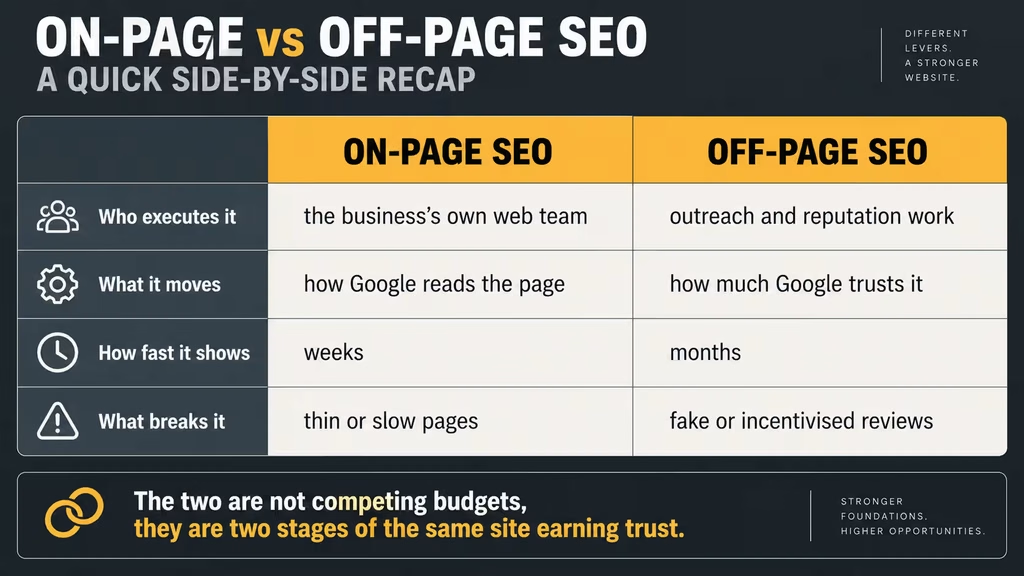
on-page vs. off-page SEO
On-page SEO is everything a business edits directly on its own site: content, structure, speed, and metadata. Off-page SEO is everything earned outside the site: backlinks, reviews, citations, and mentions. On-page usually shows results in weeks and off-page in months, which is why the two get budgeted and measured differently.
Pulled together, the distinction comes down to four questions worth asking before spending on either side:
- Who executes it: the business’s own web team or outreach and reputation work
- What it moves: how Google reads the page, or how much Google trusts it
- How fast it shows: weeks for on-page fixes, months for off-page authority
- What breaks it: thin or slow pages on-page, fake or incentivized reviews off-page
Businesses that keep this recap in mind rarely need to relearn on-page vs. off-page SEO mid-project. The two are not competing budgets; they are two stages of the same site earning trust.
Conclusion
On-page vs. off-page SEO is not a competition between two tactics; it is a sequencing question most businesses get backward. On-page work is the faster, cheaper, more controllable half, and it is what makes every review, citation, and backlink earned afterward actually worth something. Off-page work is what tells Google, and increasingly AI answer engines, that the business behind the page can be trusted.
The one concrete action worth taking this week: pull up Google Search Console and check for indexing errors or mobile usability issues before spending another rupee on backlinks or directory listings. That single check often reveals which half of the budget has been misallocated.
Businesses ready to fix both sides properly can talk to Push Digital’s brand team about where their site and their reputation actually stand today. That single conversation usually settles the on-page vs. off-page SEO question for good.
Frequently Asked Questions
What is the difference between on-page and off-page SEO?
On-page vs. off-page SEO comes down to location: on-page covers what’s editable on a website, while off-page covers external signals like backlinks, reviews, and citations that build authority.
Which is more important, on-page or off-page SEO?
Business owners searching for on-page vs. off-page SEO often want a clear winner, but neither works well alone. A well-structured site converts traffic off-page work and eventually sends it.
Should a business do on-page SEO before off-page SEO?
Yes, for most first-time SEO projects. Fixing the site first means the backlinks and reviews earned afterward send traffic to pages that can actually convert it.
Is off-page SEO the same as link building?
Link building is one part of off-page SEO, not the whole of it. Reviews, citations, brand mentions, and social signals all count as off-page too.
Do local Chennai businesses need on-page SEO?
Yes, even businesses relying mainly on local search need it. Google still reads page content and structure to decide which local result matches a search query.
How long does off-page SEO take to show results?
Off-page results typically build over several months rather than weeks, unlike most on-page fixes. Reviews, citations, and backlinks compound gradually instead of shifting rankings immediately.