
Table of Contents
A Chennai manufacturer searches for their own product category and finds a paragraph of AI-generated text sitting above the usual blue links, with no click required to get the answer. That paragraph is a Google AI Overview, and it now shapes a meaningful share of what people see before they ever reach a website. AI Overviews SEO for businesses is not a separate discipline requiring new software or a secret technique. It is the same fundamentals of indexing, structure, and genuinely useful content, applied with more discipline than most competitors bother with.
Key Takeaway: Getting cited in Google’s AI Overviews requires no special markup or paid trick. A page must first be indexed and snippet-eligible under normal search rules, then written so its answers are specific enough to extract. This matters most for Chennai service businesses and retailers whose category searches now often trigger an AI summary before a single organic result appears.
What Are Google AI Overviews and How Are They Different From AI Mode?
Google AI Overviews are short AI-generated summaries that appear above the standard results list for some searches, pulling together information from several indexed pages into one answer. AI Mode is a separate, opt-in conversational search experience where the entire results page becomes a chat-style exchange, letting a user ask follow-up questions and refine what they meant. Both run on Google’s Gemini models and draw from the same web index, but they serve different moments in a search.
The practical difference for a business owner comes down to how each one is triggered and what it replaces. An AI Overview shows up automatically, above the normal ten blue links, only when Google’s systems judge it useful for that specific query, and it often does not appear at all. AI Mode has to be opened deliberately, either through a dedicated tab or by typing a query built for back-and-forth exploration, and it replaces the results page entirely rather than sitting above it.
| Feature | AI Overviews | AI Mode |
|---|---|---|
| Trigger | Automatic, only for some queries | User opens it deliberately |
| Interface | Summary above normal results | Replaces the results page |
| Interaction | Mostly one-shot, static | Conversational, follow-up questions |
| Best suited to | Quick factual or definitional queries | Multi-part comparison or planning queries |
For a business audience, the two features reward the same underlying work: content that answers a real question clearly and can be trusted as a source. What differs is reach. A one-line Overview answer might pull a single fact from your page. An AI Mode exchange can draw on several of your pages across a longer conversation. That is one reason a shallow, single-page approach to this topic falls short.
Why AI Overviews SEO for Businesses Has No Secret Ranking Trick

Google’s own AI Features documentation states plainly that there is no AI Overviews-specific markup and no hidden ranking lever. Eligibility comes from being indexed and snippet-eligible under standard Search technical requirements. Visibility from there follows the same helpful-content and structured-data principles as classic Search. Any pitch promising a proprietary AI-citation methodology separate from that is selling a label, not a mechanism.
This matters because the inbox pitch is everywhere right now. Agencies in Chennai and globally are packaging “AI SEO” or “GEO” as a new service line. The claims: guaranteed AI Overview placement, proprietary frameworks, an urgency that rests on nothing Google has actually confirmed. The pattern across a dozen such service pages reviewed for this piece repeats. Strong claims about results. Almost no reference to Google’s own documentation.
The honest version is less exciting and more useful. Google states that the same foundational SEO best practices apply to AI features as to Search overall: a page has to meet technical requirements, follow Search policies, and be genuinely helpful and people-first. A business that already does this well for classic Search has done most of the work AI Overviews eligibility requires. The gap that remains is about extractability and freshness, not a trick nobody else has found.
Do You Still Need to Rank in the Top 10 to Get Cited?
Not as reliably as it used to. An Ahrefs analysis of 863,000 keywords and 4 million AI Overview URLs, covered by Search Engine Journal in March 2026, found something striking. Only 38% of cited pages also ranked in the top 10 organic results for the same query, down from 76% in a July 2025 version of the same study. The remaining citations split almost evenly between pages ranking 11 to 100 and pages ranking beyond position 100.
Google’s documentation points to why. When a search triggers an AI Overview, the system can break the original query into several related sub-queries. It then pulls whichever pages perform well across that broader set, a process often called query fan-out. A page that never ranks top 10 for the exact phrase a customer typed can still get cited, as long as it answers one of the sub-questions clearly and specifically. That is a real shift from the “rank first, get cited” assumption most agency pitches still lean on.
The practical takeaway is not that rankings stopped mattering. A page still has to be indexed and free of the barriers that keep it out of Search altogether. What has changed is that a single top-10 position is no longer a reliable proxy for AI visibility. A business is better served by covering a topic thoroughly across related questions than by chasing one keyword’s position.
What Actually Makes a Page Eligible for AI Overviews

Most guides to AI Overviews SEO for businesses skip straight to writing advice and miss the gate that comes before it: eligibility.
A page becomes eligible to appear as a supporting link in AI Overviews or AI Mode once it meets one condition. It must be indexed and eligible to be shown in Google Search with a snippet, meeting the same technical requirements as classic Search results. There is no additional gate specific to AI features. Beyond that baseline, whether a page actually gets pulled into an answer depends on the same quality signals Google has always described: helpful, reliable, people-first content demonstrating real experience and expertise.
That baseline is easy to miss because it is unglamorous. A page blocked by a noindex tag, caught in a soft 404, or excluded by a canonical pointing elsewhere cannot appear in an AI Overview. It was never eligible for a classic snippet in the first place. This is the first thing worth checking, because no amount of rewriting fixes an indexing problem.
Once indexing is confirmed, the E-E-A-T signals Google has described for years still apply. Real expertise on the topic. Verifiable authorship. Content demonstrating actual experience rather than a summary of someone else’s summary. Structured data such as Article or Organization schema does not create eligibility by itself. But it helps Google associate content with a verifiable entity, which supports the trust signals that influence whether a synthesis system treats a page as citable.
Writing Content Google’s AI Can Actually Use
Extraction favours a specific kind of writing that most business blogs do not naturally produce. A claim that needs the two sentences before and after it to make sense is one an AI system will usually skip. It will favour something self-contained elsewhere instead. The fix is structural. Answer the question the heading raises within the first one or two sentences under it. Then use the rest of the paragraph for the mechanism, the exception, or the number behind it.
Structure headings around real questions
Headings phrased the way a person actually searches, rather than as generic labels, give both readers and AI systems a clear signal of what the section resolves. “What Drives Web Design Cost” tells a reader exactly what follows; “Cost Considerations” does not. This does not mean every heading needs a question mark. A mix works better: a few phrased as direct questions pulled from real search behaviour, the rest as specific statements that make an actual point.
Name the source, not just the claim
A sentence stating a fact without naming where it comes from reads as an assertion, not evidence, and synthesis systems weigh named, verifiable sources more heavily than unattributed ones. “WCAG 2.2 requires a 4.5:1 contrast ratio” is citable in a way “accessibility guidelines recommend good contrast” is not, because one names a specific document and number, and the other names nothing.
Push Digital has been building brands out of Chennai for more than 25 years. The same discipline that keeps a brand identity system consistent across every channel keeps a website’s content structured well enough to survive both a human skim and a machine extraction pass. Clear headings. One idea per section. A claim backed by something specific rather than a vague assurance.
What This Looks Like for a Chennai Business
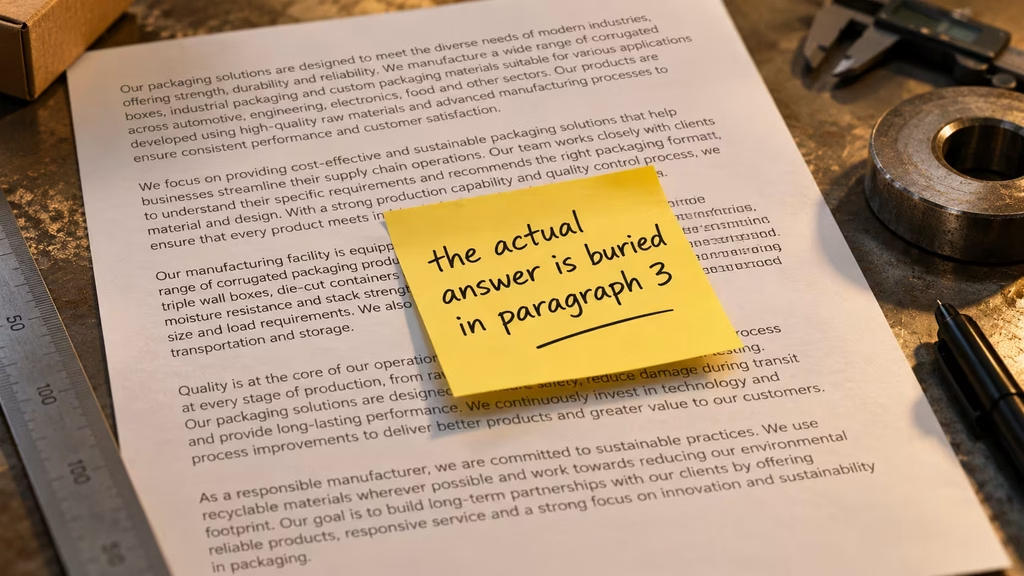
Take a mid-sized packaging supplier on the Ambattur industrial corridor. Their website answers “what packaging material suits food-grade exports” somewhere in a five-paragraph block that also covers pricing, minimum order quantities, and company history in one continuous run of text. A person reading it eventually finds the answer. An AI system generating a summary is more likely to skip the paragraph entirely, since the answer is buried. It will pull a competitor’s shorter, cleaner explanation instead, even if that competitor ranks lower in classic search.
The fix is not a rewrite of the whole site. It is separating that one answerable question into its own heading, answering it directly in the opening sentence, and letting the pricing and history live in their own sections. A retail business on OMR or a clinic near Sholinganallur faces the identical structural problem, and untangling it does more for AI Overview eligibility than any schema plugin.
Local relevance plays a limited role too. Google’s guidance describes no location-specific AI Overview ranking factor. An India or Chennai angle earns visibility the way it always has: by making content genuinely more useful to the audience searching, not by triggering a regional algorithm.
What Should You Do About It This Month?
Most businesses do not need a new strategy for AI Overviews SEO for businesses this month. They need to confirm the basics are in place, since a surprising share of eligibility problems trace back to technical issues unrelated to AI. The checklist below is built from the reasoning in this article and is a starting point, not a guarantee.
Push Digital’s 5-Point AI Overview Readiness Check:
- Confirm indexing. Check that key pages are not blocked by noindex tags, broken canonicals, or crawl errors in Search Console, since none of the rest matters if a page cannot appear in Search at all.
- Answer first, explain second. Rewrite the opening one to two sentences under each heading so they resolve the question on their own, before any supporting detail.
- Name a source per major claim. Attach a platform, a guideline, or a number to every claim that currently reads as a general assertion.
- Match headings to real questions. Rework generic section labels into the phrasing a customer would actually type, drawn from search behaviour rather than internal jargon.
- Keep a visible update date. Refresh and date content connected to anything that changes, such as pricing, service scope, or a regulation, since stale pages lose out to fresher ones in both classic and AI-generated results.
Working through these five points does more for AI Overview visibility than any packaged “AI SEO audit,” because it addresses the mechanism Google has actually described rather than a workaround for one it has not.
Conclusion
AI Overviews SEO for businesses comes down to fundamentals most Chennai companies already half-know: get indexed properly, answer questions directly, and name a real source for every claim that matters. Skip the packages promising guaranteed placement. Start this week by checking Search Console for indexing problems on your most important pages. That single check catches more eligibility failures than any AI-specific tactic will. Talk to our brand team if you want a second pair of eyes on where your content buries the answer.
Frequently Asked Questions
What is Google AI Mode and how is it different from AI Overviews?
AI Mode is a conversational search experience users open deliberately, replacing the results page entirely. AI Overviews are automatic summaries above standard results, both built on Gemini.
Do you need to rank in the top 10 to be cited in AI Overviews?
No. An Ahrefs study of 863,000 keywords found only 38% of cited pages ranked top 10, down from 76% eight months earlier. Query fan-out lets other pages get cited too.
Does getting cited in an AI Overview replace the need for classic SEO?
No. A page must still be indexed and snippet-eligible under standard Search requirements before it can be cited. AI Overviews build on classic SEO rather than replacing it.
Is there a special schema markup just for AI Overviews?
No. Google’s documentation confirms there is no AI Overviews-specific markup. Schema types like Article and Organization simply help associate content with a verifiable entity, as in classic Search.
Will AI Overviews reduce traffic to my website?
For queries an Overview fully answers, some click-through decline is likely, since users get the answer without visiting a site. Being cited as a source link can partly offset this.
How long does it take to see AI Overview citations after changing content?
There is no fixed timeline, since Overviews depend on Google re-crawling and re-evaluating a page. Confirming indexing and refreshing content regularly gives the best chance of being picked up sooner.