


Table of Contents
A Chennai retailer collects three website quotes: Rs 8,000, Rs 32,000, and Rs 75,000. All three promise a “professional business website,” but none list what that phrase includes. The retailer picks the cheapest one and finds out four months later that hosting, SSL, and mobile testing were never part of the deal.
That gap between quoted price and delivered scope is the real story behind web design cost, and it is why a single number can never answer the question honestly. Push Digital has been building brands out of Chennai for more than 25 years, and the pattern we see most often with new clients is not that their old website was expensive. It is that nobody explained what the price was buying.
Why Web Design Quotes in Chennai Vary So Wildly

Web design costs swing from under Rs 5,000 to over Rs 1,50,000 in Chennai because “website” describes wildly different products under one label. A Rs 5,000 quote is usually a pre-built template with a logo swapped in and no custom design work. A Rs 75,000 quote from an established studio typically includes custom UI/UX, on-page SEO structure, and post-launch support. The number alone tells you nothing until scope is defined.
Picture a local retail chain collecting quotes from five vendors for what it describes to each one as “a business website with five pages.” One vendor assumes a static template. Another assumes custom design with a content management system. A third assumes a fully responsive build with speed optimization baked in. All five return wildly different numbers, and the business has no way to compare them because none of the quotes started from the same scope document.
This is not a Chennai-specific problem, but it shows up harder here because the market has an unusually wide spread between volume template shops and full-service studios, with little standardization of what a “basic website” package contains. A Rs 999 website and a Rs 60,000 website can both be described as “we’ll build your site,” and the buyer has no reason to ask what that covers until the invoice arrives.
Freelancers, small studios, and established agencies also price the same scope differently because their cost structures differ, not because one is dishonest and the other fair. A freelancer working solo has lower overhead and can quote lower for the same deliverable but usually cannot match an agency’s turnaround time or its structured review process. An agency’s higher web design cost is often paying for redundancy: if one designer is unavailable, the project does not stall.
The most reliable way through this spread is to stop asking “What does a website cost?” and start asking, “What does this specific scope cost from a vendor who can show comparable work?” That reframing alone removes most of the confusion a first-time buyer runs into.
The Real Cost Drivers Behind Any Website Quote
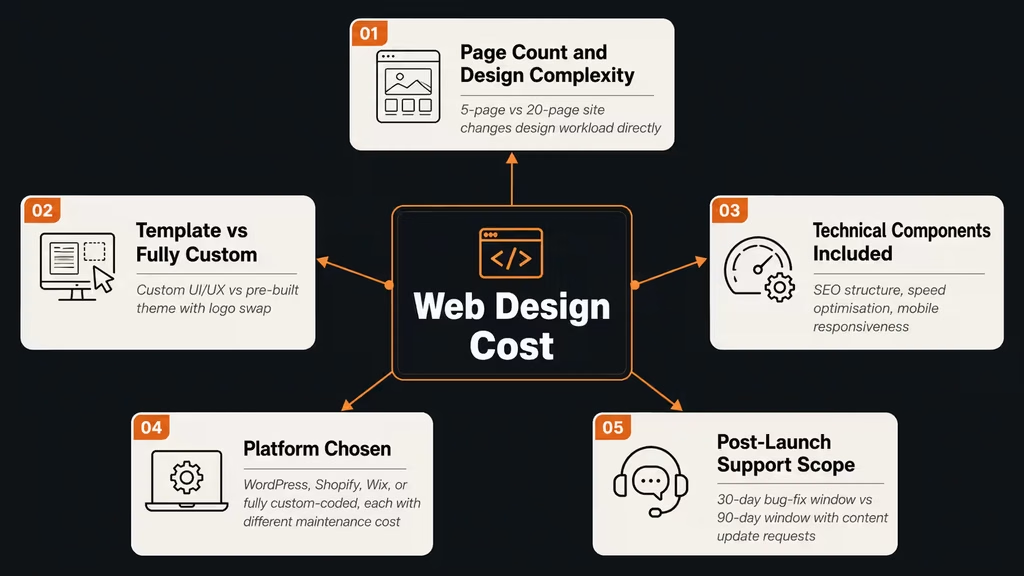
Five variables move web design cost more than location or vendor size: page count and design complexity, whether the build is template-based or fully custom, which technical components are included, the scope of post-launch support, and the platform chosen. Understanding these five before requesting a quote turns a vague number into a comparable one.
Page count sets the design workload directly. A five-page site needs five unique layouts at most; a twenty-page site with subpages, a blog, and a careers section needs a template system that still looks intentional throughout, not five pages repeated fifteen times. Platform choice changes the cost structure too: WordPress, Shopify, Wix, and fully custom-coded builds each carry different development time and long-term maintenance costs, and a quote that omits the platform is one you cannot properly compare.
The line items left out of a web design cost quote matter as much as the ones listed. Content writing is usually assumed client-supplied unless stated otherwise. Logo files that are not already vector-ready add separate design cost. None of this makes a quote dishonest, but one that does not name its exclusions deserves a second read before signing.
Post-launch support is the fifth driver, and the one most first-time buyers underweight. Thirty days after launch covers almost nothing beyond bug fixes. Ninety days with a defined number of content update requests is a genuinely different commitment, and it should be a separate, priced line item rather than a vague promise in the proposal’s closing paragraph.
Design complexity compounds with the other four drivers rather than sitting apart from them. Custom illustrations, animated transitions, and interactive elements each add design hours a clean, minimal layout does not need, and two quotes for the same page count can differ by tens of thousands of rupees purely on this detail work. Asking a vendor to itemise hours against these five drivers, rather than accepting one bundled figure, is the fastest way to see where the estimate is actually going.
What a Chennai Web Design Budget Actually Buys in 2026
Web design cost in Chennai roughly sorts into three tiers, and knowing which one a quote belongs to prevents most confusion.
| Approach | What It Typically Includes | Best For |
|---|---|---|
| Template-based (freelancer or volume shop) | Pre-built theme, logo swap, minimal customisation, basic responsive layout | A single-page portfolio or a business that needs a placeholder online presence fast |
| Custom-designed (small studio or mid-size agency) | Brand-aligned layout, custom UI/UX, blog section, contact forms, basic SEO setup | Small to mid-sized businesses that need a polished, differentiated site and plan to keep it three to five years |
| Full-service (established agency) | Fully custom design, advanced functionality, CRM integrations, structured SEO foundations, dedicated post-launch support | Larger businesses that need multiple service pages, careers pages, or third-party integrations |
Market pricing for these three tiers varies significantly between vendors quoting the same scope, which is exactly the substantiation problem this article opened with: publishing a single verified Rs figure for each tier would misrepresent a market where identical-sounding packages differ by an order of magnitude. The one number worth anchoring web design cost comparisons to is GST. Web design invoices in India carry GST, and quotes that omit whether that 18% is included or added on top are a common source of budget surprises at invoice time.
E-commerce functionality changes the web design cost calculation independently of page count. Payment gateway integration, inventory management, and product catalog structure all add development time a static informational site never touches, and a store quote needs to name which of those three components is included before it can be compared against another.
Chennai’s market has a specific pattern worth naming: a large share of the cheapest quotes come from freelancers and volume shops competing almost entirely on price, which pushes the visible “average” web design cost lower than a properly scoped custom build actually costs. A first-time founder searching for web design cost benchmarks online sees these low numbers first and anchors to them, then is surprised when a capable studio quotes several times higher for what looks, on paper, like the same five-page site.
Businesses that get the most value match their tier to their growth horizon, not their current budget alone. A startup testing a product line for six months has a case for a template-based build. A retail brand scaling content and running paid campaigns for the next three years does not, because the redesign a template-based site eventually forces usually costs more than the custom build would have upfront.
The Compliance Costs Most Quotes Leave Out
Two compliance requirements affect nearly every Chennai business website and rarely appear in a web design cost quote: data consent on lead forms and accessibility on body text. Neither is optional, and neither raises cost meaningfully when built in from the start, which is why fixing them later costs more than including them on day one.
Section 6 of the Digital Personal Data Protection Act, 2023, requires that consent for collecting personal data be free, specific, informed, unconditional, and unambiguous, given through a clear affirmative action. A contact form with a pre-ticked consent checkbox does not meet that standard, and the Act’s core obligations carry a compliance deadline of 13 May 2027, meaning a site built today should already meet the standard rather than be retrofitted later.
Accessibility carries its own named requirement. WCAG 2.2 accessibility criteria, Success Criterion 1.4.3, require a contrast ratio of at least 4.5:1 for body text and 3:1 for large text and interface components. Many brand colour palettes fail this on their primary brand colour when applied directly to body copy, which is why the contrast check belongs in the design stage, before colours are locked into the CMS, not during a post-launch accessibility audit.
A properly structured consent checkbox and a contrast-checked colour palette are design decisions, not separate line items requiring extra developer hours. The real cost only appears later, when an audit reveals existing forms were never compliant and the fix now requires touching every page the form appears on, rather than one design file before launch web design cost .
For businesses handling personal data through their site, whether a simple enquiry form or a full customer account system, asking a vendor whether DPDP-compliant consent language and WCAG contrast checking are already included in the quote is a fair, increasingly necessary question. A vendor who cannot answer clearly has not built either requirement into their process.
Common Mistakes Businesses Make When Comparing Quotes

The single most common mistake in comparing web design cost across vendors is comparing the number before comparing the scope document behind it. A Rs 15,000 quote and a Rs 60,000 quote are frequently not describing the same deliverable, even when both use the word “professional.”
A second mistake is assuming the cheapest quote is the cheapest total web design cost. A low-cost template build that needs a redesign within eighteen months because it cannot support a blog or basic SEO structure ends up costing more across three years than a properly scoped custom build upfront. The comparison that matters is the total across the life of the site, redesign included.
A third mistake is treating maintenance as an afterthought. Hosting, security updates, and support plans are almost always priced separately from the initial build, and a quote that bundles a free first year of maintenance is often recovering that cost in the renewal price.
A fourth mistake, specific to Chennai, is comparing a freelancer’s quote against an agency’s as though they are the same purchase. A freelancer’s lower web design cost reflects lower overhead, not lower quality by definition, but it means less accountability if the freelancer becomes unavailable mid-project. An agency’s higher quote buys a team and continuity years after launch. Neither is automatically wrong; the mistake is not accounting for the difference.
How to Evaluate a Web Design Quote Before You Sign

A web design cost quote can be evaluated properly in five questions asked before any number is compared: what platform is being used, whether the design is template-based or custom, what happens to SEO and mobile responsiveness, what post-launch support period is included, and who owns the source files and admin access after handover.
- Confirm the platform by name. WordPress, Shopify, and a fully custom build carry different ongoing costs; a quote without one is incomplete.
- Ask whether the design is templated or custom. This single answer explains most of the price gap between two quotes for the same page count.
- Ask what SEO and mobile optimisation means in the proposal. “SEO-ready” can mean a properly structured sitemap, or nothing more than a plugin left unconfigured.
- Get the post-launch support period and its scope in writing. Bug fixes and content updates are different commitments, and only one of them is usually included free.
- Confirm file and access ownership at handover. A business that does not own its own admin login and source files is not free to leave the vendor later.
Reviewing our portfolio of business websites before requesting a quote gives a business a working sense of custom design at different web design cost levels, which makes the next quote easier to read.
What Drives Cost Up After Launch
Web design cost does not end at launch. Domain renewal, hosting, SSL certificates, and maintenance are recurring costs separate from the build fee, and skipping them in year one is the top reason a website budget looks wrong in year two. Domain renewal runs a few hundred to a few thousand rupees annually, and hosting scales with traffic, from shared plans to dedicated servers.
Redesigns are the other recurring cost businesses rarely budget for. Design standards shift enough that most sites need a meaningful refresh every three to five years, not because the original build failed, but because a five-year-old pattern reads as dated against current competitors.
Content updates, new integrations, and analytics setup also tend to surface after launch rather than during it. A business that pairs its website with ongoing digital marketing services, such as structured analytics tracking, typically finds these costs easier to plan for because they are scoped alongside the site rather than discovered piecemeal.
Treating web design cost as a single upfront figure, rather than a build cost plus predictable ongoing costs, is the biggest reason business owners feel blindsided eighteen months after launch. Budgeting for domain renewal, hosting, maintenance, and an eventual refresh at the outset turns these into planned line items instead of surprise expenses.
Conclusion
Web design cost in Chennai is not one number, it is a scope document wearing a price tag. Businesses that get value from their spend ask what a quote includes before asking how much it costs, because a Rs 15,000 quote and a Rs 60,000 quote rarely describe the same deliverable. This week, run whatever quote is sitting in your inbox against the five evaluation questions above before signing. If the answers are vague, that vagueness is the real web design cost you are paying. Talk to our team for a second opinion before you commit.
Frequently Asked Questions
Why do website design quotes vary so much in Chennai?
Web design cost varies because “website” isn’t standardised. A Rs 5,000 template and a Rs 75,000 custom build are both called a business website, but the design work differs completely.
What is included in a typical web design package?
Web design cost coverage varies by vendor, but most packages include design, basic development, and a set page count. Hosting, content writing, and SEO configuration are frequently excluded.
How can I reduce my web design cost without cutting quality?
Limit the initial page count to what the business genuinely needs at launch, adding sections later as needed. This keeps the design workload focused without forcing a template-only build.
Do web design quotes usually include hosting and domain?
Not by default. Many quotes bundle a first year of hosting and domain registration as an incentive, then charge separately for renewal, so this should be confirmed before signing.
What ongoing costs come after the website launches?
Domain renewal, hosting, SSL renewal, and security maintenance are the recurring costs, typically billed annually or monthly. Budgeting for these upfront avoids surprises once the first support period ends.
Is DPDP compliance something my web design agency should handle?
Yes, at the technical level. The agency builds consent mechanisms into lead forms correctly, though the business stays legally responsible for how collected data is used afterward.



uyuyiyu