
Table of Contents
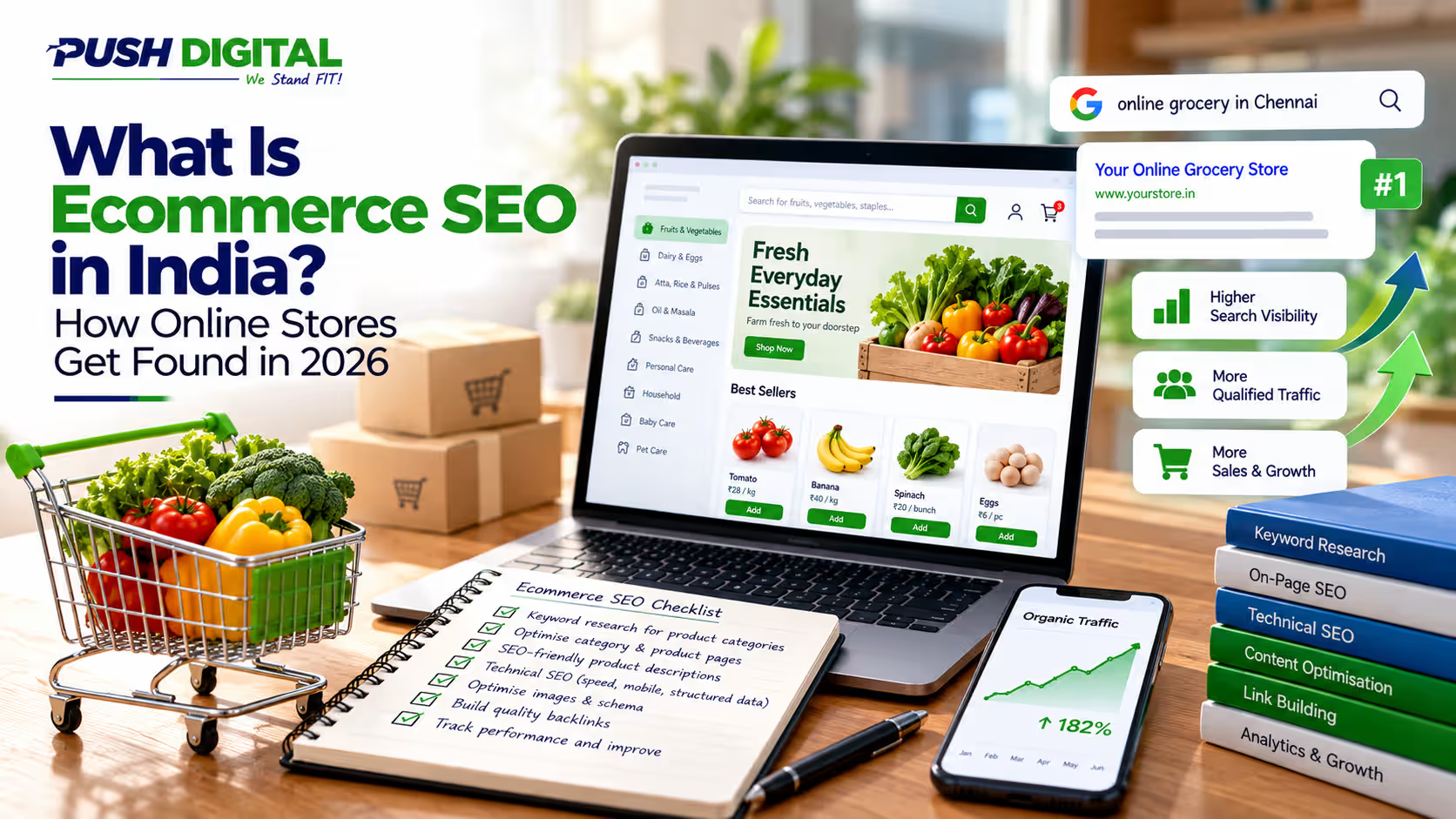
Say a saree retailer in T. Nagar sells through Instagram and a Shopify store. Every quarter the same thing happens: ad costs creep up, and sales stop the day the budget does. Ecommerce SEO in India is the work of making that store appear when shoppers search for what it sells, so part of the traffic arrives without a charge for every click.
This guide explains how ecommerce SEO for small business owners differs from regular SEO, where Google and marketplaces each fit, and what drives the price. It also gives a five-point check for deciding what to fix first.
Key Takeaway: Ecommerce SEO for an Indian store means fixing crawl problems, category pages, product data and page speed for Google, then deciding separately how much effort marketplace listings deserve. Small stores should start with category pages and expect gradual movement over months.
Where Ecommerce SEO Departs From Regular SEO
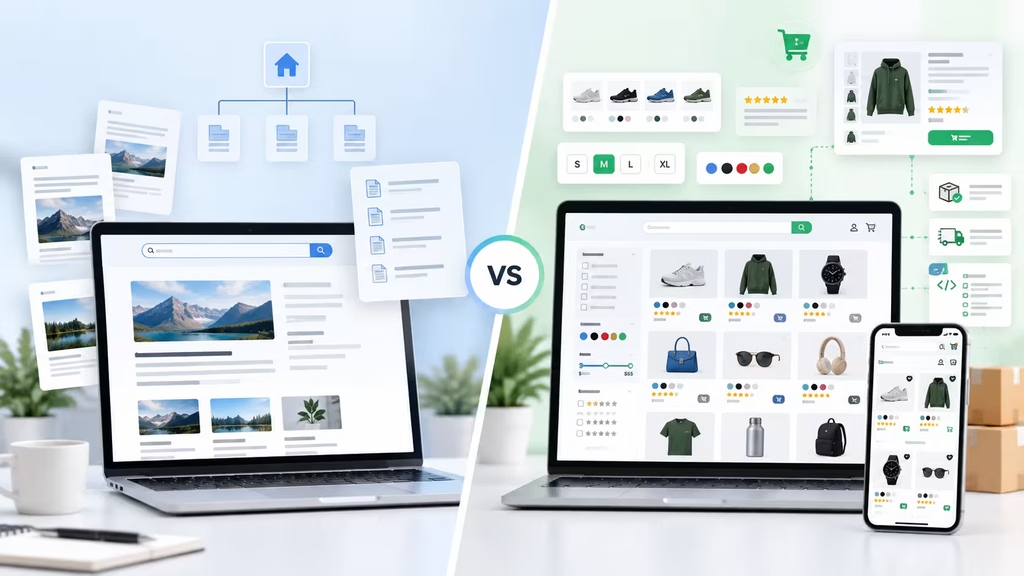
Ecommerce SEO is the practice of getting an online store’s category and product pages to rank for searches where the shopper is ready to buy. It differs from regular SEO because a store has hundreds of near-identical pages, filters that create duplicate URLs, and stock that changes daily, and each of those needs a rule.
A blog or a service website can rank on a handful of pages. A store has to keep thousands of pages reachable, distinct and current. Duplicate content from colour and size variants, pages for sold-out items and filter URLs become routine problems.
Search intent shifts too. A shopper typing “cotton kurtas for women” is browsing. One who adds a size, a colour or a price limit is close to buying, and those narrower searches are the ones a store should aim to win. Product photography also carries search weight. Google says product information can appear in Google Images and Google Lens, so clean product image design works for rankings as well as for conversions.
The Indian market adds its own wrinkles. Ecommerce SEO in India has to cope with shoppers who compare one item across Amazon, Myntra and a brand’s own site. Some buyers finish the sale on WhatsApp, and traffic spikes around festival sales and wedding season.
Does Ecommerce SEO in India Mean Google, Marketplaces, or Both?
For most stores it means both, run as separate jobs. Website SEO earns rankings on Google for pages you own. Marketplace listings on Amazon, Flipkart or Myntra rank inside each platform under that platform’s own rules. The website builds an asset and a customer list you control, while the marketplace rents you access to its shoppers.
The difference between marketplace SEO vs website SEO comes down to who owns the relationship. On a marketplace you can shape the listing title, images, price and stock, but the platform decides the ranking, sets the fees and keeps the buyer’s details. The catch on your own site is that nobody sends you traffic until the pages rank.
| Factor | Website SEO (Google) | Marketplace SEO (Amazon, Flipkart, Myntra) |
|---|---|---|
| Who sets rankings | Google’s search systems | The marketplace’s own algorithm |
| What you control | Site structure, content, markup | Listing title, images, price, stock |
| Customer data | Held by your store | Held by the marketplace |
| Brand building | Full control of pages and design | Limited to the listing template |
| Main dependency | Google algorithm changes | Marketplace rules and fees |
Google also takes product data directly. Feeds uploaded to Google Merchant Center follow a product data specification that Google says is used to match products to the right queries, so an accurate feed supports both free listings and ads.
Timing matters in this market. Changes made in the week of a Deepavali sale rarely get found, stored and ranked by Google in time to help. Website work belongs in the months before the season, with marketplace listings updated closer to it.
Fix Category Pages Before Product Descriptions

Most owners start by rewriting product descriptions. A category page usually returns more for the same effort, because it matches the broad search (“cotton kurtas for women”) and links down to every product in that range. One well-built category page can serve searches that no single product page could.
Good category page optimisation is mostly plain work. Give each page a unique heading that names the range, an opening paragraph on what it covers and who it suits, and internal links to the strongest products and sub-categories. Ecommerce SEO for Shopify and WooCommerce stores follows these same rules, though each platform handles URLs, filters and templates in its own way, so check what your theme allows before paying a developer.
Faceted navigation and out-of-stock pages
Filters let shoppers narrow a range by size, colour or price, and each combination can create a new URL. Faceted navigation SEO is the job of deciding which combinations earn an indexed page of their own, such as “red cotton kurtas”. The rest should be blocked or pointed to a main category, so Google spends its crawl time on pages worth ranking.
Sold-out and discontinued products need a decision too. Keep the page live with alternatives if the item will return, redirect it to the closest match if it will not, and return a 410 (gone) status only when nothing relevant exists.
Product data and schema
Product schema markup is code on a page that tells Google a product’s name, price, availability and reviews in a form it can read. Google’s Product structured data documentation distinguishes product snippets, for pages where a shopper cannot buy, from merchant listings, for pages where they can. It also says that supplying both page markup and a Merchant Center feed maximises eligibility for Google’s shopping experiences.
Keep the markup in step with the visible page. When the price in the code and the price on screen differ, the store is handing Google two answers.
What Sets Ecommerce SEO Cost in India?

Ecommerce SEO cost in India depends on four things: how many products and categories the store has, which platform it runs on, how competitive its categories are, and how much written content it needs. Catalogue size usually moves the price most, because product-level work grows with every SKU, meaning each individually sellable item.
Published price guides for Indian stores disagree widely, and most come from agencies selling the service, so the ranges reflect that agency’s own pricing rather than a market rate. Treat any single figure, high or low, as a cue to ask what the work covers.
| Cost driver | What it changes | Why the price moves |
|---|---|---|
| Catalogue size | Number of pages to audit and write | Product-level work grows with each SKU |
| Platform | Which fixes need a developer | Shopify, WooCommerce and custom builds differ |
| Competition | Time needed to reach page one | Crowded categories need more content and links |
| Content load | Category copy and guides | Written pages are priced per page or per month |
| Marketplace scope | Extra channels to manage | Amazon and Flipkart listings need separate work |
Consider a manufacturer in Ambattur whose new B2B ordering site lists thousands of SKUs. Its bill will lean toward crawl control, filters and templates, while a small D2C brand’s will lean toward category copy and product photography.
A useful quote lists how many category pages get rewritten, whether product pages are included, which technical fixes are covered, and how progress is reported. Organic sales and traffic belong in that report alongside keyword positions. Ads and SEO also work better when planned together, because paid campaigns show which searches convert before a store commits months of organic effort. That is the case for a shared digital marketing plan.
Push Digital’s Store SEO Priority Check
A common version of this: a store with 300 products, no copy on its category pages, and a homepage that stalls on a mid-range phone. The owner wants to start with a blog. That order leaves the cheap wins untouched.
Push Digital, a Chennai-based 360° branding and digital marketing agency, recommends its Store SEO Priority Check as a starting order for owners deciding what to fix first. Each row names what to test, the sign that it is broken, and the first fix by catalogue size.
| Check | Broken when | Under 100 products | 100 to 1,000 products | Over 1,000 products |
|---|---|---|---|---|
| Crawl and index health | Category pages missing from Search Console | Submit sitemap, fix broken links | Audit filter URLs and duplicate pages | Control filter URLs and crawl paths |
| Category pages | Product grid with no intro copy | Write copy for top five categories | Write copy for every category with demand | Template plus manual copy for top categories |
| Product data and schema | Price or stock missing from markup | Add markup to best sellers | Automate through the platform | Generate from catalogue data |
| Speed and mobile | Slow product images on phones | Compress hero images | Fix image loading in templates | Set a speed budget per template |
| Measurement setup | No organic sales reporting | Link Search Console and Google Analytics 4 | Track revenue by category | Report by template and category |
Core Web Vitals for online stores come down to three measures of how a page behaves for real visitors. web.dev’s Core Web Vitals guidance sets three thresholds for a good score. Largest Contentful Paint (how fast the main content appears) should take 2.5 seconds or less. Interaction to Next Paint (how fast the page reacts to a tap) should be 200 milliseconds or less. Cumulative Layout Shift (how much the layout jumps) should be 0.1 or less. The guidance measures them at the 75th percentile of page loads, so most visits must meet each target.
Test each row on a mid-range phone as well as a fast laptop, because ecommerce SEO in India has to work for shoppers on both.
Push Digital has been building brands out of Chennai for more than 25 years. Design is treated as part of search work here rather than a finishing coat, because a page that ranks still has to look trustworthy before a visitor buys.
Conclusion
Ecommerce SEO in India rewards stores that fix things in order: crawl health first, then category pages, product data, speed and measurement. The order matters because each layer depends on the one before it, and a well-written category page still earns nothing if Google cannot index it.
This week, open Google Search Console and check whether your five biggest category pages are indexed (listed by Google) and appear for a search on their exact names. Note which ones are missing, and fix those before writing anything new. Then run the Store SEO Priority Check above against your product count.
Stores that want a second view on page design, product imagery or their digital marketing plan can talk to our team. Bring your top categories and current ad spend to that first conversation.
Frequently Asked Questions
What is ecommerce SEO in simple terms?
Ecommerce SEO is the work of making an online store’s category and product pages appear when shoppers search Google. It aims for steady traffic from people ready to buy.
Does ecommerce SEO work for Shopify and WooCommerce stores?
Yes, both platforms can rank well when the store is set up properly. The platform changes which fixes are easy, such as editing URLs, filters and page templates.
Is ecommerce SEO worth it for a small store in India?
It can be, when the store sells products people search for and the owner can wait months. Stores needing sales this week are better served by ads first.
How much does ecommerce SEO cost in India?
Prices vary widely because they depend on catalogue size, platform, competition and content needs. Compare quotes by scope, not by headline monthly fee, and ask what work each line covers.
How long does ecommerce SEO take to show results?
Expect months rather than weeks, because changed pages must be found and ranked against pages that already hold links. Technical fixes tend to show movement before new content does.
Should I optimise category pages or product pages first?
Start with category pages, because each one matches broader searches and links to many products. Move to product pages once categories, crawl health and page speed are sound.