Table of Contents
Take a neighbourhood clinic in Chennai that has run the same two ads for three months. The budget has not changed and neither has the audience, yet the cost of each enquiry keeps climbing. The owner opens the targeting menu and finds fewer controls than a year ago.
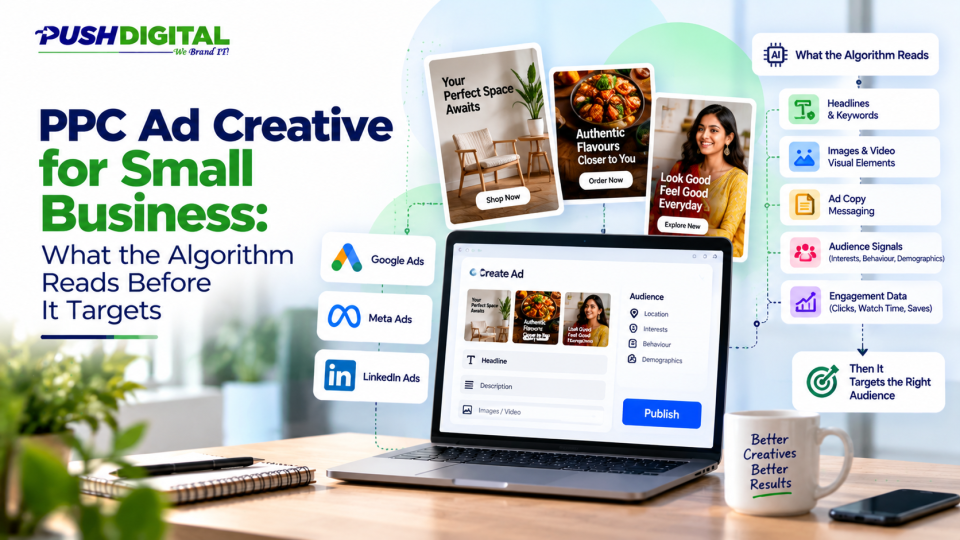
For most small advertisers, what is left is the ad itself. Google and Meta now choose who sees each ad, so the message does much of the sorting, and that makes PPC ad creative for small business the first place to look when results stall. People call this idea “creative is the new targeting,” and the label is accurate.
Key Takeaway: Better ad performance does not come from producing more creatives. It comes from writing the right message for the right audience, testing it on purpose, and improving it from real performance data. This applies to any business running Google Ads or Meta ads on a modest monthly budget.
Does Creative Matter More Than Targeting in Performance Max and Meta Ads?
In automated campaigns, creative now does much of the work that targeting used to do, because Performance Max and Meta Advantage+ decide delivery themselves. You supply audience signals, a budget and the ads, and the platform learns who responds to which message. A vague ad gives that system little to learn from, so reach and cost both suffer.
Google’s asset group documentation defines an asset group as a collection of creatives built around a theme or a target audience. Any asset in the group can combine with any other to build ads across Search, Maps, Display, YouTube, Gmail and Discover. The audience signals in Performance Max, which are hints about your ideal customer, start the learning, but in practice the ads you upload decide who keeps responding.
The table below shows where control sits now.
| Decision | You still control | The platform decides |
|---|---|---|
| Who sees the ad | Audience hints and location | Final delivery |
| Where it appears | Formats you upload | Placement and surface |
| What it costs | Budget and goal | Bids in each auction |
| Which ad is shown | The pool of ads you build | Which ad suits which person |
| What the ad says | Headlines, images, offer | Extra text if enabled |
Say a clinic runs broad targeting with an ad that only says Book now. The system finds people who tap that button, and nothing in the ad tells it which of them need the clinic’s treatment. An ad that names the condition, the neighbourhood and the first-visit offer does the sorting before the click. That is the practical meaning of “creative is the new targeting.”
Performance Max Wants Assets, Meta Wants Distinct Ideas
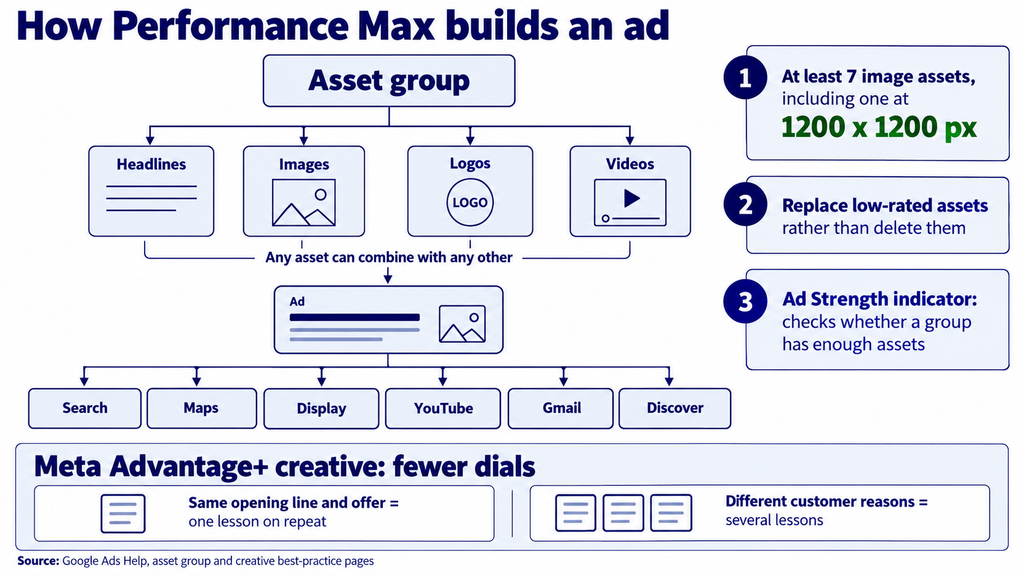
Performance Max builds each ad by combining headlines, images, logos and videos from an asset group. Performance Max creative assets therefore work as building blocks, and thin or repetitive ones cap the number of different ads the system can assemble. Richer asset groups give it more combinations to test.
Google’s best-practice guidance for Performance Max creative assets asks advertisers to add at least 7 image assets, including one at 1200 x 1200 pixels, and to replace low-rated assets rather than delete them. Google’s asset group page also points advertisers to the Ad Strength indicator as the check for whether a group has enough assets.
Meta Advantage+ creative gives you fewer dials. The system learns from how people respond to each finished ad. Ads that share an opening line and offer teach it one lesson on repeat, while ads built on different customer reasons teach it several.
How Many Ad Variations Does PPC Ad Creative for Small Business Really Need?
Most small advertisers need fewer ads than online guides suggest, provided each one makes a different argument. For a small monthly budget, our team starts with 2 to 3 distinct creative variations and adds more only when results show where the next test should go.
Search “how many ad creatives do I need” and the answers run from a handful to dozens, rarely with a source behind the number. The spread exists because the advice mixes budgets. A large account can give dozens of ads enough impressions to learn from, while a small account that splits its budget across many ads leaves each one too little data to judge. Meta Andromeda creative diversity is a fair goal, but diversity means different arguments, not the same ad in five colours.
At Push Digital, a Chennai-based 360° branding and digital marketing agency, we disagree with adding creatives for their own sake. Before our team makes another variation, we review the audience, the messaging, the offer, click-through rate (the share of people who click after seeing an ad), conversions and lead quality. Every new creative has to test one clear hypothesis, such as a new offer or a new opening line. Refreshes follow results rather than a fixed schedule. Our creative team handles the agreed designs, copy and refreshes, and the client supplies updated offers, product details and approvals. That split is how we run Google Ads and Meta campaign management for smaller budgets.
Pongal, Deepavali and Tanglish: Where Local Creative Changes the Signal

Take a jewellery showroom in T. Nagar that starts its Deepavali ads two weeks before the festival, using last year’s banner with a new date. By the time approvals clear, demand is already peaking, and the platform has had almost no time to learn which message works this year.
Festival timing is a planning problem before it is a design problem. Push Digital has been building brands out of Chennai for more than 25 years. For PPC ad creative for small business in Tamil Nadu, we plan major festive campaigns 4 to 6 weeks ahead, especially when video or several campaign assets are involved. The calendar runs through concept, copywriting, design, approval, launch and optimisation, and the aim is to go live ahead of peak demand. Wedding-season campaigns follow regional demand and how customers buy.
Language is part of the message too. An ad in Tamil or Tanglish, the Tamil and English mix people use in everyday speech, tells a viewer who it is for before they click. An English-only ad aimed at a Tamil-speaking neighbourhood may not. For many Chennai businesses the next step after a click is a WhatsApp message, so a WhatsApp click-to-chat ad should promise the offer the chat will confirm. You can see the kinds of ads and brand assets we produce in our recent campaign work.
A Seven-Point Brief the Algorithm Can Actually Use
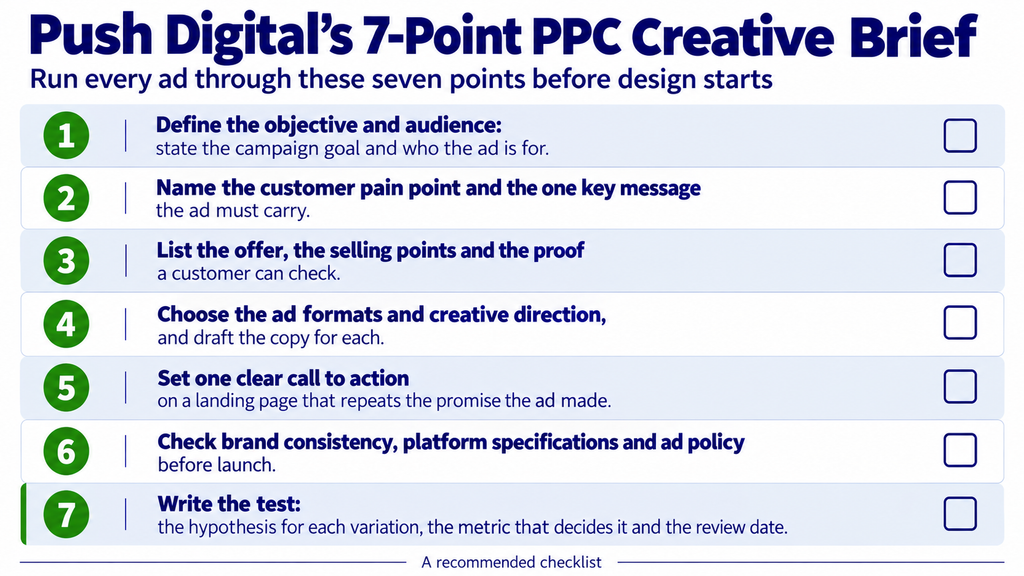
The mistake our team sees most often is an ad that looks good but never says why a customer should choose the business. We also see overcrowded designs, generic messaging, weak offers and unclear calls to action. Push Digital’s 7-Point PPC Creative Brief is the checklist we recommend for PPC ad creative for small business, whether an agency or an in-house team produces the work.
Run every ad through these seven points before design starts:
- Define the objective and audience: state the campaign goal and who the ad is for.
- Name the customer pain point and the one key message the ad must carry.
- List the offer, the selling points and the proof a customer can check.
- Choose the ad formats and creative direction, and draft the copy for each.
- Set one clear call to action on a landing page that repeats the promise the ad made.
- Check brand consistency, platform specifications and ad policy before launch.
- Write the test: the hypothesis for each variation, the metric that decides it and the review date.
Point 7 is where ad creative testing stops being noise. Search Engine Land reports that Google is rolling out asset experiments for Performance Max, which compare new asset groups, the effect of adding single assets, and seasonal creative against evergreen creative. Watch for creative fatigue in PPC as well: when click-through rate falls while targeting and budget stay the same, the audience has probably seen the ad too often and a refresh is due.
Conclusion
Good PPC ad creative for small business starts with a clear message and two or three distinct ads. This week, write one sentence per live ad naming the customer, the problem and the offer, then replace any two ads that say the same thing with a different argument. If you want a second opinion, talk to our brand team and bring your current ads with last quarter’s enquiry numbers. We will start with the message before touching the settings.
Frequently Asked Questions
Does creative matter more than targeting in PPC now?
Targeting still sets the boundaries, but creative decides who responds inside them. Platforms read engagement to choose who sees each ad, so a vague message limits reach.
How many ad creatives do I need for Meta ads?
For a small monthly budget, we recommend starting with 2 to 3 distinct variations. Each should test a different message, so the budget is not spread too thin.
How often should I refresh my ad creative?
Refresh when results show a need, such as falling click-through rate or rising cost per lead. Dated events like a festival sale are the exception and need earlier preparation.
Can I A/B test creative in Performance Max?
Yes, Google is rolling out asset experiments for Performance Max campaigns. They compare new asset groups, the effect of adding single assets, and seasonal creative against evergreen creative.
What is creative fatigue and how do I spot it?
Creative fatigue is the drop in response when the same audience sees the same ad too often. Watch for falling click-through rate and conversions while targeting and budget stay unchanged.
What should a creative brief for PPC ads include?
A brief covers the objective, audience, pain points, offer, proof, formats, call to action, landing page, platform checks and testing. Our seven-point checklist puts these