

Table of Contents
A sensor assembly fails a salt-fog test three weeks before a client demo. The culprit is not the circuit design. It is the coating, a liquid acrylic that pooled in one corner and left a connector exposed. This is the moment most engineers first go looking for parylene coating services, usually after a cheaper coating has already let them down once.
Parylene is not a new material. It has been used in electronics and medical devices for decades, but most first-time buyers still do not know how it differs from the liquid coatings they have already tried, or what actually drives its cost. This guide covers what parylene is, how the coating process works, which grade fits which application, and what a Chennai-based manufacturer should know before requesting a quote for parylene coating services.
What Parylene Coating Actually Is
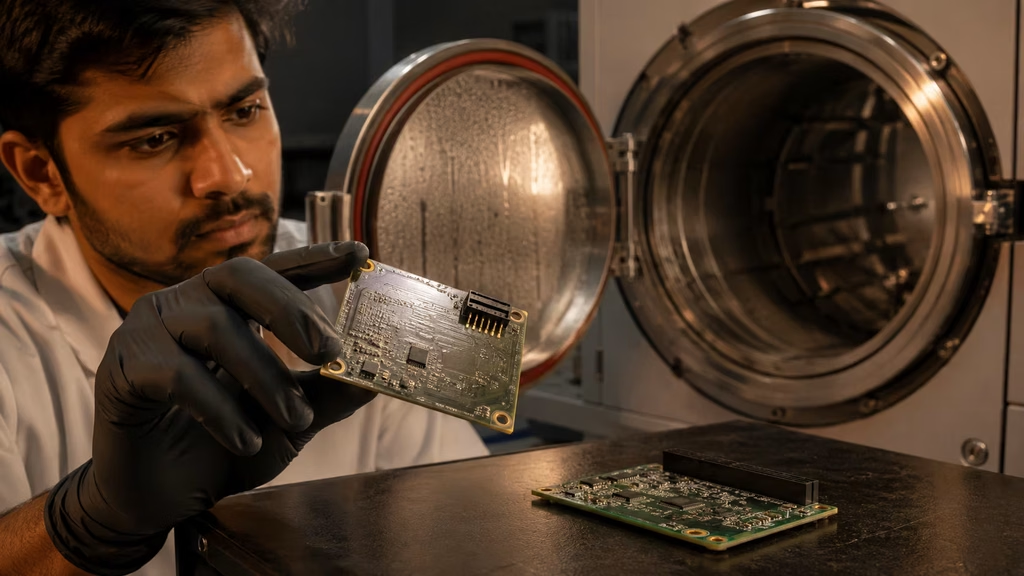
Parylene coating is a vapor-deposited polymer film that forms a uniform, pinhole-free barrier over a component’s entire exposed surface, including gaps and crevices liquid coatings cannot reach. It protects against moisture, chemical attack, and dielectric breakdown. Unlike acrylic, silicone, or urethane conformal coatings, parylene is never sprayed, dipped, or brushed. It arrives as a gas.
That gas-phase application is the detail most engineers miss on their first parylene coating project. Because the material never exists as a liquid on the part, there is no surface tension to fight, no pooling in corners, and no thick spots on vertical edges. A connector pin and the flat board beside it receive the same film thickness, which is exactly what a liquid coating cannot promise. This single mechanical difference explains most of why teams switch to parylene after a coating failure rather than choosing it first.
The confusion usually starts with terminology. “Conformal coating” is the broad category, covering acrylic, silicone, urethane, epoxy, and parylene alike. Parylene is one specific type of conformal coating, distinguished by its vapor-phase application. A buyer searching for parylene coating services sometimes arrives assuming any conformal coating supplier can deliver it, only to learn that parylene requires a dedicated vacuum deposition chamber, not the spray booths or dip tanks used for liquid coatings.
That equipment difference is also why parylene coating services sit at a different price point than a basic acrylic spray coat. Engineers who understand this upfront tend to specify parylene deliberately for the parts that genuinely need it, rather than defaulting to it for every board on a project.
How the Parylene Coating Process Works
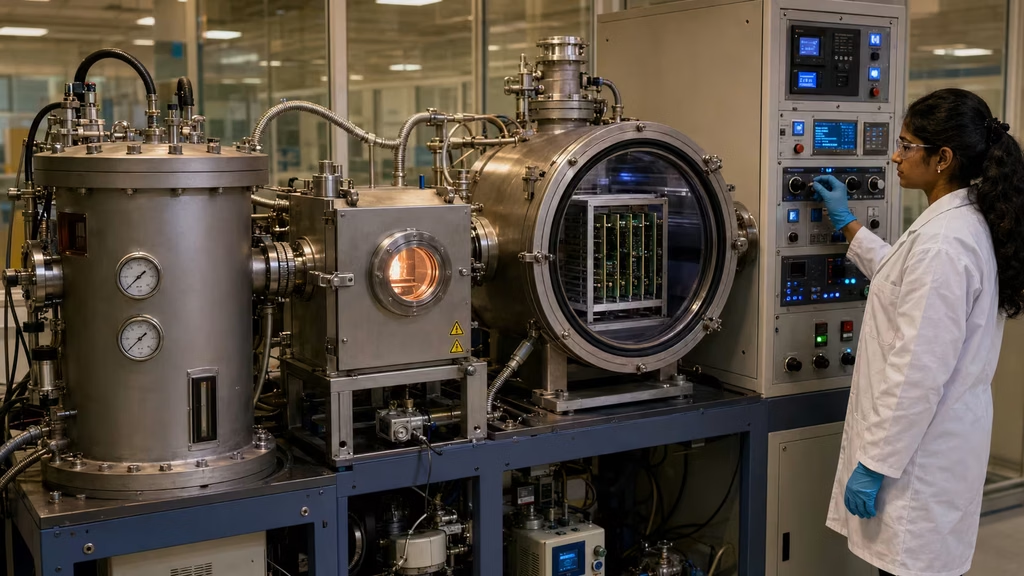
Parylene coating is applied through chemical vapor deposition, a three-stage process that converts a solid dimer into a thin polymer film without ever passing through a liquid state. The dimer is heated to sublime into a gas, broken down into a reactive monomer, then deposited onto the part inside a vacuum chamber. The entire process runs at or near room temperature.
From Dimer to Film: The Three-Stage Process
The first stage vaporizes the raw parylene dimer, a stable powder, into a gas without a liquid phase in between. The second stage, pyrolysis, breaks that vaporized dimer down into a reactive monomer gas at high temperature. The third stage is deposition, where the monomer gas enters the coating chamber and condenses onto every exposed surface of the part, forming the film molecule by molecule.
Because deposition happens at room temperature, parylene coating services work on components a hot cure cycle would damage, including some plastics, adhesives, and pre-assembled units with heat-sensitive parts already installed. That is a genuine constraint most liquid coatings cannot meet, since urethane and epoxy conformal coatings typically require an oven cure that assumes the whole assembly can tolerate sustained heat.
Before deposition begins, the part goes through masking and cleaning, and this stage matters more than most first-time buyers expect. Any surface that must stay coating-free, a connector, a test point, or a mechanical contact needs a physical mask applied before the part enters the chamber. Common masking materials include specialized tapes, dip masks, and mechanical fixtures, chosen based on the geometry being protected and how cleanly the mask needs to release after coating. Parts also need to be clean and fully dry before coating, since parylene will conformally coat contamination along with the surface itself, locking in anything that was not removed first.
Getting masking wrong is the most common reason a first run with parylene coating services needs rework. A mask that shifts during the vacuum cycle, or one that was never designed for the part’s actual connector geometry, leaves either an unwanted coated contact or an unprotected gap. Reviewing the masking plan against the real board layout, not a simplified drawing, before the first production batch runs is the single step that prevents most of these failures. Wikipedia’s overview of parylene’s chemical vapor deposition process covers the underlying chemistry in more depth for engineers who want the full mechanism.
Parylene C, N, and D: Choosing the Right Grade
Parylene comes in several commercial grades, and Parylene C, N, and D are the three most commonly specified for electronics and industrial parts. Each trades off dielectric strength, moisture barrier performance, and chemical resistance differently, so the right grade depends on the part’s operating environment rather than a single default choice.
Parylene C is the grade most engineers reach for first. It offers a strong balance of moisture barrier and dielectric properties and adheres well to most substrates, which makes it the default recommendation for general electronics protection. Parylene N carries a higher dielectric strength and better penetration into tight crevices, useful where fine-pitch components sit close together. Parylene D adds greater thermal stability, which matters for parts that will see sustained higher operating temperatures after coating.
Choosing between them is not a guessing exercise. It comes down to naming the part’s actual operating conditions: the temperature range it will see in service, the chemicals or moisture it will be exposed to, and whether dielectric performance or crevice penetration matters more for that specific geometry.
A useful way to think about grade selection is to separate the question into two parts. First, what does the part need to survive in service: humidity cycling, salt exposure, sustained heat, or aggressive cleaning solvents during maintenance. Second, what does the part’s geometry demand from the coating itself: tight connector spacing that needs maximum penetration, or a simpler board where general moisture protection is the only real requirement. Answering both questions before requesting a quote turns grade selection from a guessing exercise into a specification decision, and it gives the coating supplier the information needed to recommend a grade rather than default to whichever one they stock most.
Design and engineering teams should treat the parylene grade as a line item in the design record, not a note added after the board is already in production. Specifying the grade early also gives parylene coating services enough lead time to validate masking around any newly added fine-pitch components.
Parylene Coating for Manufacturers in Chennai and Tamil Nadu
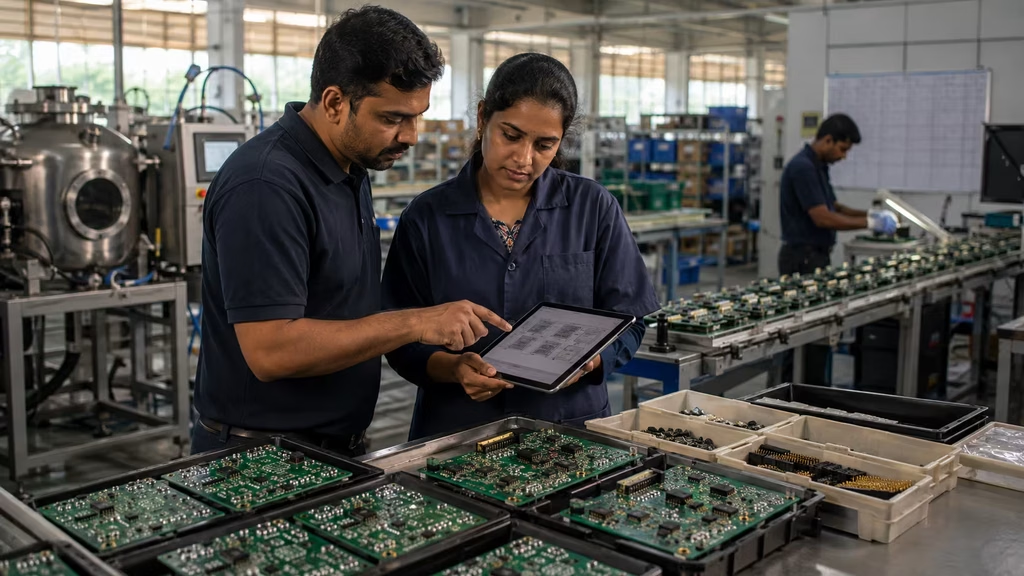
Chennai has become one of India’s established electronics manufacturing hubs, anchored by the EMS corridor stretching from Sriperumbudur to Oragadam. For manufacturers operating inside that corridor, parylene coating services solve a specific local problem: sourcing a reliable, room-temperature coating process without shipping finished assemblies overseas and adding weeks to a production timeline.
Push Digital has been building brands out of Chennai for more than 25 years. That regional grounding shapes how we think about specialty finishing services like parylene, particularly for manufacturers inside Chennai’s electronics manufacturing corridor. A local sourcing decision is not just about coating quality. It is about turnaround time, communication with the coating team during masking review, and the ability to visit a facility before committing a production batch to it.
Manufacturers in the corridor increasingly treat parylene coating services as a specification decision made early in product development, not a late-stage fix applied after a field failure. Building that decision into the design phase avoids the scramble that follows a salt-fog test failure three weeks before a client demo, and it gives engineers time to validate masking plans against the actual board layout instead of reworking them under deadline pressure.
Local sourcing also changes how quality control happens in practice. A supplier three time zones away communicates masking questions over email with a full day’s delay built into every exchange. A Chennai-based coating partner can review a physical part, discuss a masking plan face to face, and turn around a revised sample within the same production week. For a startup or a mid-size manufacturer running lean, that difference in iteration speed often matters more than a marginal per-unit cost saving from an overseas supplier.
There is also a practical customs and logistics angle worth naming directly. Shipping assembled boards out of the country for coating and back again adds transit time, import documentation, and the risk of in-transit damage. Keeping the parylene coating services step inside the same manufacturing region removes that entire layer of risk from the production schedule.
Common Misconceptions That Delay a Coating Decision
The most common misconception about parylene coating services is that they cost too much to consider for anything but aerospace or implantable medical devices. In practice, parylene is cost-competitive once total cost of ownership is weighed against corrosion-related repairs, warranty claims, and field failures a thinner or unevenly applied liquid coating tends to produce.
A second misconception is that parylene coating services cannot rework or remove a coated part once it is applied. Parylene can be selectively removed with plasma etching or mechanical methods when a board needs rework, though this adds a process step that should be planned for at the specification stage rather than discovered mid-repair.
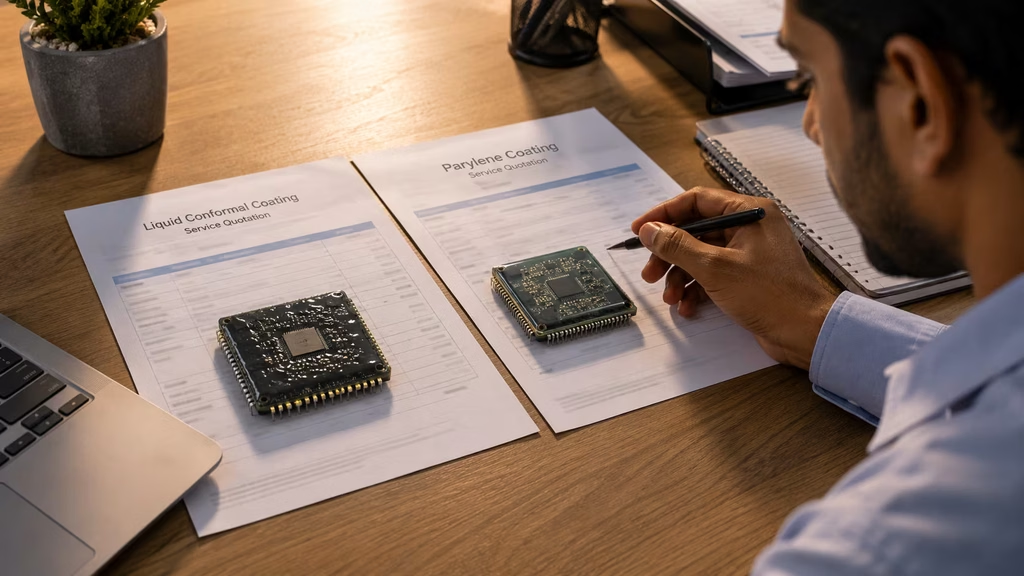
Picture a procurement manager comparing two supplier quotes side by side, one for liquid conformal coating and one for parylene coating services, and choosing the lower number without asking what thickness or coverage each quote actually delivers. Two quotes at different price points are rarely coating the same amount of material to the same standard, which is why the coverage specification matters more than the headline price. Examples of our production work show what that coverage standard actually looks like on a finished part.
A third misconception, common among engineers ordering parylene coating services for the first time, is that any parylene grade will work for any application. It will not. Choosing Parylene C for a part that will see sustained high operating temperatures, when Parylene D was the better fit, is a specification error that only surfaces months later when the coating begins to degrade in service. Naming the operating environment before picking a grade avoids this entirely.
Parylene vs Liquid Conformal Coating: A Decision Framework
Parylene coating services and liquid conformal coating both protect electronics from moisture and contamination, but they differ in application method, coverage consistency, and cure requirements. The table below breaks down the practical differences an engineer needs before specifying either one for a new project.
| Factor | Parylene Coating | Liquid Conformal Coating |
|---|---|---|
| Application method | Vapor deposition in vacuum chamber | Spray, dip, or brush |
| Coverage on complex geometry | Uniform on all exposed surfaces including crevices | Uneven, prone to pooling and thin spots |
| Typical film behavior | Pinhole-free, molecularly thin | Thickness varies by application technique |
| Cure requirement | None, forms at room temperature | Usually requires oven cure or extended air dry |
| Best-fit use case | Fine-pitch boards, complex 3D assemblies, heat-sensitive parts | Simple flat boards, larger production runs, lower unit cost |
Fine-pitch boards and parts with tight tolerances tend to favor parylene coating services because the vapor-phase process reaches gaps a spray gun or dip tank physically cannot. Larger, simpler assemblies where per-unit cost matters more than crevice coverage often do better with a liquid coating instead.
What Actually Drives Parylene Coating Cost
The cost of parylene coating services is not a fixed per-unit number. It moves with four factors: the surface area being coated, the target film thickness, the complexity of the masking required to protect connectors and contacts, and the batch size going through the coating chamber at once.
Surface area and thickness set the base material cost, since a thicker film or larger surface consumes more dimer per run. Masking complexity adds labor cost separately, because every connector or contact that must stay coating-free needs to be physically protected before the part enters the chamber and cleaned afterward. Batch size affects cost per unit more than any other factor, since a coating chamber run has largely fixed overhead regardless of how many parts fill it.
A buyer requesting a quote for parylene coating services should expect a supplier to ask about all four factors before pricing the job, not offer a flat rate off a price list. A quote given without asking about masking complexity is usually a sign the supplier has not actually reviewed the part. If you would rather walk through your part’s masking requirements before requesting numbers, talk to our team about your project.
Timeline is worth asking about alongside price, since the two are connected. A small prototype batch through a coating chamber runs faster than a full production lot, but rushing a production-scale masking job to hit an unrealistic deadline is where quality slips. Building a realistic timeline for parylene coating services into the overall product schedule, rather than treating it as a same-week turnaround that can be squeezed in anywhere, protects both the budget and the part.
Conclusion
Parylene coating services solve a specific problem: protecting complex, fine-pitch, or heat-sensitive parts in ways liquid conformal coatings structurally cannot match. The grade selection, the four real cost drivers, and the masking review are not obstacles to work around. They are the actual specification process, and treating them that way from the start avoids the scramble that follows a failed salt-fog test.
For manufacturers in Chennai’s electronics corridor, the practical next step is simple: bring the part specification to Push Digital’s parylene coating service before the design is finalized, not after a field failure forces the conversation. Early masking review saves both time and rework.
Frequently Asked Questions
What is parylene coating used for?
Parylene coating services protect electronics, sensors, and medical devices from moisture, chemicals, and dielectric breakdown. They are common in aerospace, automotive, and implantable medical device applications.
How is parylene coating applied?
Parylene is applied through chemical vapor deposition inside a vacuum chamber. A solid dimer is vaporized, broken into a reactive gas, then deposited as a film at room temperature.
How much does parylene coating cost?
Parylene coating services price by surface area, target film thickness, masking complexity, and batch size. A reliable quote requires a supplier to review the actual part, not a flat price list.
Is parylene coating better than other conformal coatings?
It depends on the part. Parylene suits fine-pitch geometry and heat-sensitive assemblies, while liquid coatings can be more cost-effective for simpler, larger production runs.
What industries use parylene coating?
Electronics, medical devices, aerospace, and automotive manufacturers all use parylene coating services, particularly where moisture resistance and dielectric strength determine whether a part survives in the field.
How thick is a parylene coating?
Parylene films are typically applied as thin, uniform layers measured in microns rather than millimeters, with thickness set by dimer quantity loaded into the chamber.
Can parylene coating be removed or reworked?
Yes. Parylene coating services can selectively remove the film using plasma etching or mechanical methods, though rework should be planned for at the specification stage, not discovered mid-repair.