Table of Contents
Say a Chennai furniture retailer searches for her best-selling sofa and finds a rival in position one. The rival’s blog holds twelve buying guides. Hers holds two. She spends a week guessing at topics and publishes four posts that nobody searches for. Knowing how to find content gaps would have given her a short list of pages worth writing instead.
This guide, from Push Digital, a Chennai-based 360° branding and digital marketing agency, shows a manual method that needs only a sitemap and Google. It ends with a scorecard that decides which gaps deserve your time.
Key Takeaway: A content gap is a question your reader asks that your site answers badly or not at all, and a competitor’s sitemap shows you where theirs does better. Small teams should score each gap on demand, fit, beatability, effort and proof, then fill only the ones that score 8 or more.
What Is a Content Gap, and What Is Just a Competitor’s Habit?
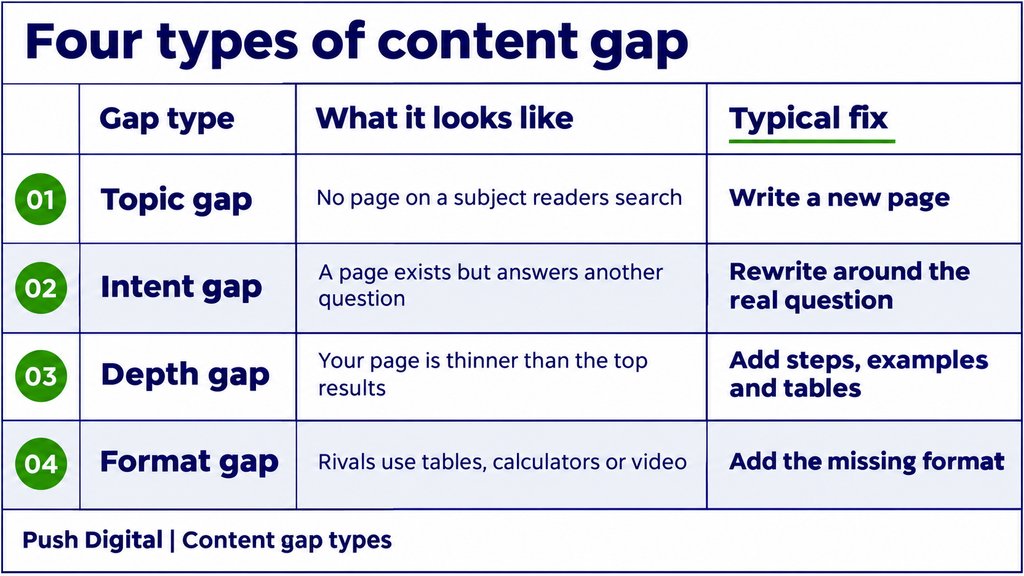
A content gap is a topic, question or format that your audience searches for and your site covers poorly or not at all. A keyword gap is narrower: a term a rival ranks for and you do not. Many keyword gaps are not content gaps, because the competitor’s page may serve a reader you don’t want.
Keyword gap vs content gap is more than wordplay. An export lists every term a rival ranks for, including ones tied to products you do not sell. Sort each finding into one of four types before you spend a day on it.
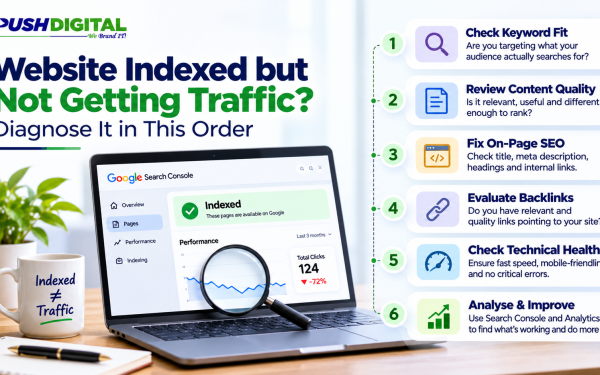
This sorting is the core of competitor content gap analysis: compare what a reader gets from their page and from yours, not whose keyword list is longer. First rule out your own faults, though. A page may underperform because of indexing or technical problems, and our guide to a website that is indexed but not getting traffic lists the order to check them in.
How to Find Content Gaps Using Only a Sitemap and Google
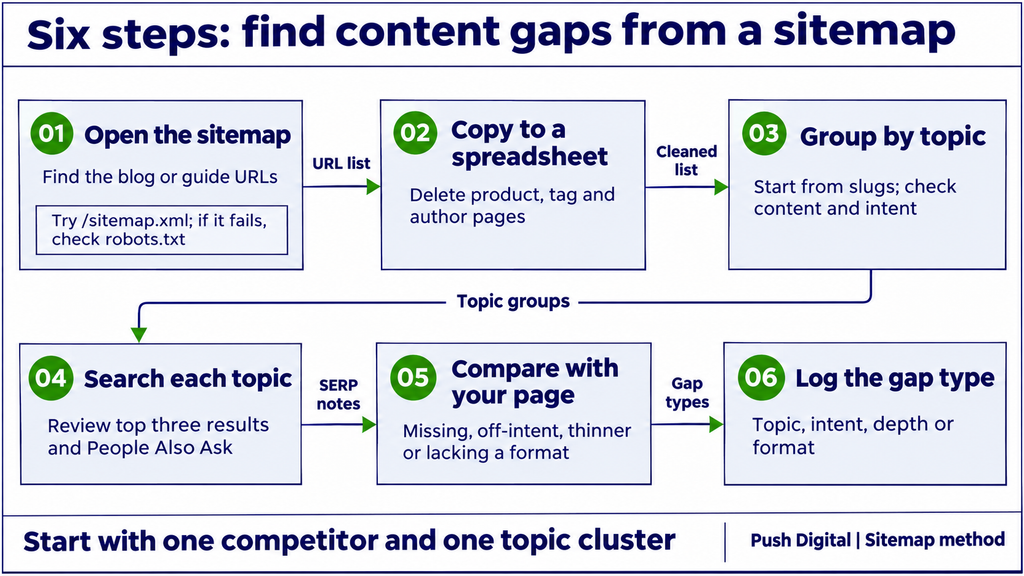
To find content gaps in a competitor’s website without a paid tool, list their pages from the sitemap, group them by topic, then search each topic on Google and compare the top results against yours. The gaps are the topics where they have a page and you have none, or where theirs answers more.
Start with the file the competitor already published for search engines. Google’s sitemap documentation describes a sitemap as a file listing a site’s pages, videos and other files so that search engines can crawl it more efficiently. A competitor’s sitemap is a useful starting point for discovering important URLs, although it may not contain every page, and a listed page is not guaranteed to be indexed. In practice, adding /sitemap.xml to their domain works on most sites, and the robots.txt file usually names the address when it does not.
Work through it in this order:
- Open the sitemap and find the list of blog or guide URLs.
- Copy those URLs into a spreadsheet and delete product, tag and author pages.
- Group the URLs by topic, starting from the slugs. Multiple URLs covering related questions may indicate a topic cluster. Review their content and search intent before grouping them.
- Search each topic on Google the way a customer would, run a quick SERP analysis of the top three results, and note any People Also Ask questions.
- Compare each result with your page on that topic. Record whether yours is missing, off-intent, thinner or lacking a format.
- Log the gap type from the table above next to each topic.
Keep the first pass to one competitor and one topic cluster. Three half-finished comparisons teach you less than one finished one.
If You Already Pay for a Gap Tool
Ahrefs’ Content Gap report and the Semrush Keyword Gap tool list terms that other sites rank for and yours does not. Use them to confirm what the sitemap method found, then drop rows that fail the intent test. Free content gap analysis tools are worth trying too, but check what they return: a keyword list covers only one of the four gap types.
Reading the Gaps in Chennai Search Results

Take a textile retailer in T. Nagar whose rival ranks for festival-shopping questions typed in Tamil and Tanglish. A tool tracking English keywords shows no gap at all, yet the rival is collecting those buyers every Deepavali.
A content gap analysis for small business in India has to account for how customers phrase a search. Run each topic three ways: in English, in Tamil and as a mix of both. Note which versions return thin pages, directory listings or nothing useful. Check the actual results page before calling any gap easy: directory listings, thin posts and strong guides each change how hard a query is to beat.
Push Digital has been building brands out of Chennai for more than 25 years. Choose rivals with that local lens: your search competitors are not always your business competitors. A national marketplace and a neighbourhood shop can rank for the same query, so pick the three rivals a Chennai customer would genuinely compare you with. For the wider set of local checks, see our local SEO checklist for Chennai businesses.
Which Gaps Are Worth Filling? A Five-Check Scorecard
A content gap is worth filling when readers search for it and it connects to something you sell. It also needs a page you can improve, a team that can publish soon, and real experience. Score each of those five checks from 0 to 2. Fill gaps totalling 8 or more, if demand and fit each score at least 1.
Push Digital’s Five-Check Gap Priority Scorecard works as a content gap analysis template for teams too small to fill every gap. It is our recommended method, and the thresholds are a starting point to adjust after your first round.
| Check | What to look at | Score 0 | Score 1 | Score 2 |
|---|---|---|---|---|
| Demand | Suggestions and related questions | No visible signals | A few signals | Repeated signals |
| Business fit | Link to a paid service | No link | Loose link | Direct link |
| Beatability | Weak spots in the top three | Top pages cover it | Partly beatable | Top pages thin |
| Effort | Time to publish | Over a month | A few weeks | Under a week |
| Proof | First-hand examples or data | None | Some | Strong |
Prioritise gaps scoring 8 or more, provided both demand and business fit score at least 1. If either scores zero, reconsider the opportunity before investing in content. A total of 5 to 7 means queue it. Below 5, skip it, however busy the competitor’s page looks.
Here is the scorecard applied to the furniture retailer from the introduction. The scores are illustrative, not research findings.
| Topic | Gap type | Score | Decision |
|---|---|---|---|
| Sofa buying guide | Topic gap | 9/10 | Fill now |
| Sofa size comparison | Format gap | 8/10 | Fill now |
| Furniture care | Depth gap | 7/10 | Queue |
Here is how the 9/10 for the sofa buying guide adds up, using the same five checks:
| Check | Score | Reason |
|---|---|---|
| Demand | 2 | Repeated suggestions and related questions |
| Business fit | 2 | Direct link to sofa sales |
| Beatability | 2 | Top results skip size advice |
| Effort | 1 | A few weeks to write |
| Proof | 2 | Owner’s showroom experience |
The buying guide goes first because a rival already wins that search and she has no page at all. The care topic waits because it ties less directly to a sofa sale.
Knowing how to find content gaps is half the work, and demand is the check people skip. The free method gives no search volume. Autocomplete suggestions, related questions and the number of rivals covering a topic are demand signals, not measurements, so score them as hints rather than forecasts.
Google Search Console provides actual query performance data for your verified website, while third-party SEO tools offer estimates of competitor keyword performance. Google’s Search Console Help explains that you can sort the Queries tab of the Performance report by clicks or impressions. Search Console cannot compare you with a rival, but it shows which queries already surface your pages. High impressions with few clicks may indicate weak rankings, an unappealing search snippet, competing SERP features or a mismatch with search intent.
Where a Manual Check Misses Things, and What AI Answers Change
A sitemap shows what a competitor has published. It does not show what they plan next, what customers ask them privately, or what AI tools say about them.
That last gap is new. Google’s guide to optimizing for generative AI features says SEO best practices still apply to AI Overviews and AI Mode, so fix the fundamentals first. Then run a small exploratory check: ask ChatGPT, Gemini and Perplexity the questions your customers type, and note whose pages they name.
Answers and citations can change between runs. Record the exact prompt, the date, the platform and every cited URL, then repeat the same prompts later and compare. A rival can appear in these answers even where it ranks poorly in classic results, so the two lists can differ. Treat this as a fourth column in any SEO competitor analysis for small business teams, and as the starting point for tracking content gaps in AI search visibility.
Published guides disagree on how often to repeat all this. Some say quarterly, others every six months. Our suggestion: re-run the sitemap pass whenever a competitor visibly changes its blog, and the full scorecard twice a year.
However well you know how to find content gaps by hand, a manual pass cannot count backlinks, track rankings over months or estimate traffic. That is where a paid tool or an agency earns its fee.
Frequently Asked Questions
What is a content gap in SEO?
A content gap is a topic, question or format your audience searches for that your site covers poorly or not at all. Competitors who answer it capture those readers instead.
How do you find content gaps in a competitor’s website?
Open their sitemap, group blog URLs by topic, search each topic on Google, and compare the top results with your page. Log every topic where yours is missing or weaker.
What is the difference between a content gap and a keyword gap?
A keyword gap is a search term a rival ranks for and you do not. A content gap is broader, covering missing topics, mismatched intent, thin depth and absent formats.
Can you find content gaps for free?
Yes. A competitor’s sitemap, Google searches and your Search Console data cost nothing. A manual pass is slower than a paid tool and will not show rankings or backlinks.
Which content gaps should a small business fill first?
Start with gaps that score 8 or more on the five-check scorecard. Those have visible demand signals, a link to something you sell, and a page you can improve.
How often should you check for content gaps?
Re-run the sitemap pass when a competitor visibly changes its blog, and repeat the full scorecard twice a year. Published guides disagree on frequency, so adjust to your publishing pace.
Conclusion
How to find content gaps comes down to two moves: read the competitor’s sitemap, then score what you find. This week, pick one rival, copy their blog URLs into a spreadsheet and group them by topic. Score the three biggest clusters with the five checks, and write the highest scorer first.
Not sure which content opportunities your competitors are winning? Let Push Digital identify the gaps and build an SEO content strategy for your business. Either way, start with one competitor and one topic.