Table of Contents
Take a clinic in Chennai that runs a lead form ad on Instagram for a month. The spreadsheet that comes back is full of enquiries. Some numbers ring out, a few belong to someone else, and the front desk spends two days calling people who barely remember filling in a form.
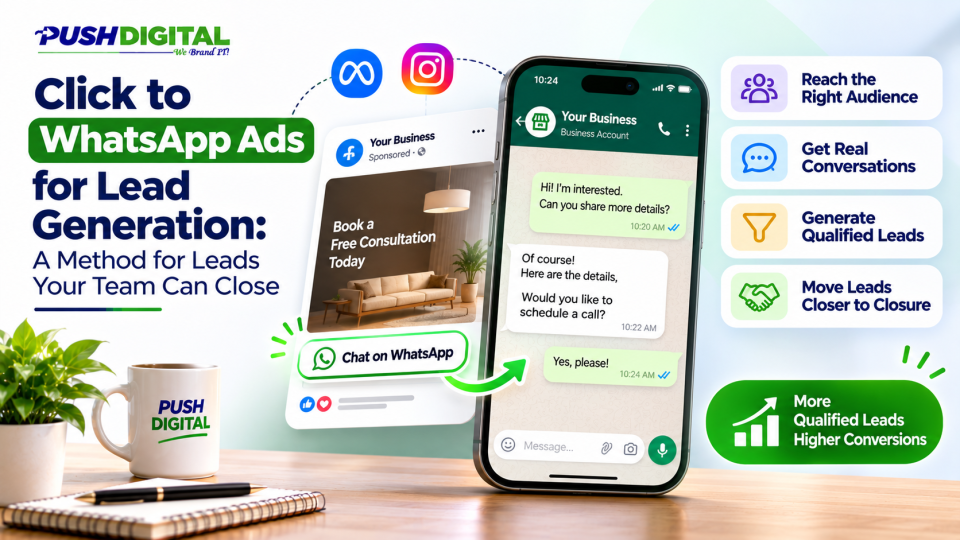
Click to WhatsApp ads for lead generation work differently. The ad opens a chat, so the first message comes from a person who chose to write, on the same phone and in the same app they use all day. That does not make the lead good on its own. Quality depends on how the campaign is set up and what happens in the first few messages.
This guide covers the Meta Ads Manager setup, the free messaging window and its effect on follow-up cost, a five-question scorecard for deciding who gets a human reply, and the mistakes that fill an inbox with chats nobody can close. It is written for Chennai and Indian businesses that already run Meta ads and want fewer dead enquiries.
Key Takeaway: Lead quality on WhatsApp comes from two decisions: setting the campaign to optimize for leads instead of conversations, and asking a short set of qualifying questions before a person replies. This guide is for owners and marketing managers who run Meta lead form ads and want enquiries their sales team can close.
What Counts as a Quality Lead on WhatsApp?

A quality lead on WhatsApp is someone who starts a chat from your ad and then shares meaningful information, such as contact details, a specific question about your service, or a clear need. Meta separates this from a lead who only says hello. Counting every chat as a lead hides the cost.
The distinction matters because a campaign optimized for conversations is built to find people who start chats. The dashboard can look healthy while the sales team has little to follow up.
Meta’s lead generation guidance for small businesses offers a fix at the setting level. Lead optimization delivers ads to people more likely to share contact details than just open a chat. In a Meta experiment covering 116,000 campaigns from 43,000 businesses between 4 and 10 November 2024, it lowered cost per lead by 24% on average compared with optimizing for conversations.
Treat that 24% as a direction, not a promise. It is an average from one week of data, and Meta notes that the setting is not available in the EU, UK, Japan or South Korea.
Why Lead Forms Leave Sales Teams Chasing Numbers That Never Pick Up
Say a salon runs a lead form ad on Instagram. One visitor types a number with a digit wrong, another uses a spare SIM, and a third has forgotten the form by the time the salon calls two days later. All three arrive in the report as leads.
A chat works from the opposite end. The person taps the button on their own phone and the message arrives from their own WhatsApp account, so the business sees a working number while interest is still fresh. The reply goes into the same thread, with no callback to schedule.
The click to WhatsApp ads vs lead form ads comparison comes down to where the first conversation takes place.
| Stage | Lead form ads | Click to WhatsApp ads |
|---|---|---|
| Path to first contact | Form fields, then a wait for a call | One tap into a chat |
| Phone number | Typed by the visitor | The account the message came from |
| First reply | Scheduled callback or email | Reply in the same thread |
| Where qualifying happens | On the callback | In the first few messages |
| Where cost shows up | Cost per form submission | Cost per chat, then per qualified lead |
Neither format guarantees quality. Click to WhatsApp ads for lead generation still attract people who wanted only a price, and a fast form callback can beat a slow chat reply.
How Do You Set Up Click to WhatsApp Ads for Lead Generation in Meta Ads Manager?
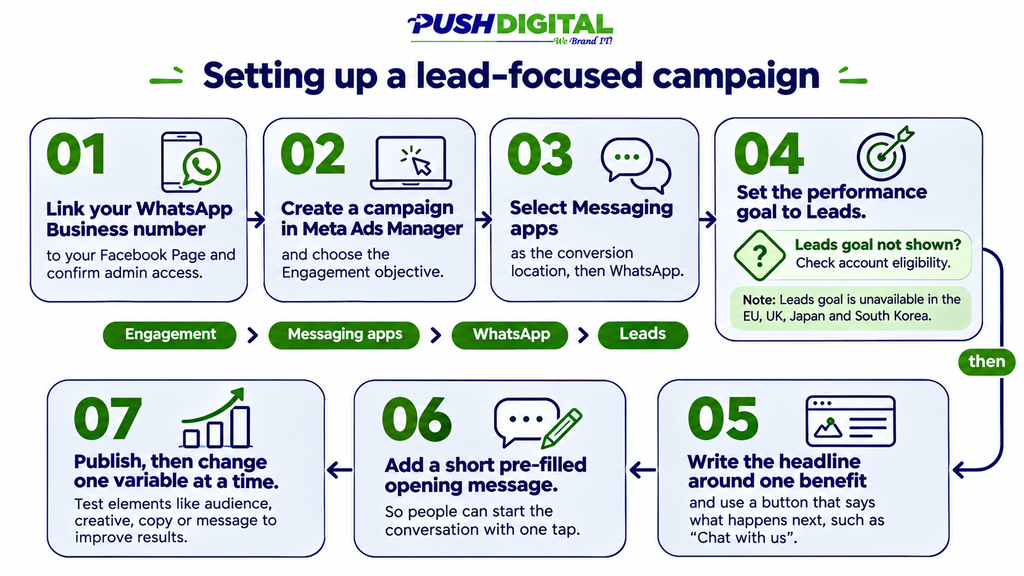
To set up a lead-focused campaign, choose the Engagement objective in Meta Ads Manager, set Messaging apps as the conversion location, pick WhatsApp, and select Leads as the performance goal. A WhatsApp Business account linked to your Facebook Page must exist first. A pre-filled opening message gives each chat context.
Start with one decision: the WhatsApp Business app or the WhatsApp Business Platform. The app suits an owner answering from a phone. The Platform adds chatbots, several agents and reporting through a provider.
This is how to set up click to WhatsApp ads for lead generation once the account is chosen:
- Link your WhatsApp Business number to your Facebook Page and confirm you have admin access to the Page.
- In Meta Ads Manager, create a campaign and choose the Engagement objective.
- Select Messaging apps as the conversion location, then choose WhatsApp.
- Set the performance goal to Leads, so delivery optimizes for leads rather than chats.
- Write the headline around one benefit and use a button that says what happens next, such as Chat with us.
- Add a short pre-filled opening message so each chat arrives with context.
- Publish, then change one variable at a time so you can tell what moved the result.
Labels in Ads Manager shift as Meta updates the interface, and the Leads performance goal may not appear for every advertiser. Check your account’s eligibility and the optimization options on your screen. If Leads is missing, choose the closest goal available and track qualified leads yourself. If a team would rather hand the build to specialists, Push Digital, a Chennai-based 360° branding and digital marketing agency, runs paid social campaign management for businesses that want the setup and the qualification flow built together.
How Long Is the Free Window on Click to WhatsApp Ads, and What Still Costs Money?

When someone messages you through a click to WhatsApp ad and you reply within 24 hours, a free entry point window opens. Updated 2026 guidance describes it as lasting up to 7 days, up from 72 hours, though rollout can vary by account. Messages sent inside that window are free to deliver.
Meta’s pricing documentation sets two conditions that are easy to miss. The person must message from the WhatsApp mobile app on Android or iOS, because desktop and web are not supported. And the window opens only after you reply within 24 hours, with its clock running from your reply. Speed still matters, but for a different reason: a lead who hears back in minutes is more likely to still be interested, so a fast reply protects conversion, not free time.
For teams running click to WhatsApp ads for lead generation, that makes the first reply the most valuable message you send. Use it to ask the first qualifying question, then use the rest of the window to send the brochure or the booking link without paying per message.
Two other 2026 changes are reported, and both depend on your account. WhatsApp software vendors and business press say that since 1 October 2026 the first 1,000 service messages per phone number each month are free and further service messages are charged. They add that utility templates sent inside the 24-hour service window are now charged too. Meta’s own pricing page still showed 72 hours and free service replies when this guide was written on 10 November 2026, so the two versions disagree. Check the pricing page and rate card inside your Business Manager, or ask your provider, before you set a budget.
Two Indian details are documented. Meta raised India’s marketing message rate on 1 January 2026, so marketing templates cost more than they did in 2025. And eligible customers, meaning partners and directly integrated clients billed in India, must move their WhatsApp Business accounts to INR billing by 31 December 2026, or Meta will stop delivering their messages from 1 January 2027. If a provider runs your setup, ask whether that migration is done.
The Five-Question Scorecard That Decides Who Gets a Human Reply
A chat becomes a lead only when someone can tell, within a minute, whether it deserves a person’s time. Push Digital’s 5-Question WhatsApp Lead Qualification Scorecard gives that decision a fixed shape for any team where more than one person, or a chatbot, handles the first replies.
Meta’s guidance suggests qualifying with questions about budget, timeline or service interest, and the scorecard extends that to five checks. Score each from 0 to 2: 2 for a clear, fitting answer, 1 for a partial one, 0 for none.
| Check | Ask in chat | Scores 2 when | Scores 0 when |
|---|---|---|---|
| Need | What are you looking for | Names the service or product | Gives no detail |
| Budget band | Which range suits you | Picks a range that fits your offer | Declines or sits far below it |
| Timeline | When do you plan to start | This week or this month | No plan |
| Serviceability | Which area are you in | Inside your service area | Outside it |
| Contact preference | Chat, call or visit | Picks one and names a time | Stops replying |
Add the five scores for a total out of 10. As a starting point, send 8 to 10 to a person immediately, give 5 to 7 an automated follow-up with a human check later the same day, and move 0 to 4 into a slower nurture list. Adjust the thresholds after a few weeks of real chats, because the right cut-off depends on how many enquiries your team can answer.
WhatsApp Flows can collect these answers through short in-chat forms instead of free typing. Learnwise, a Kerala-based higher education platform, tested a Flow in its ad setup in October and November 2025. It reported 4X more qualified leads, 60% less time spent qualifying and 31% lower cost per qualified lead, according to Meta’s Learnwise success story. Meta labels those results self-reported and not identifiably repeatable, so read them as a pattern worth testing, not a forecast.
A person, a Flow or a WhatsApp lead qualification chatbot can ask the questions, and the five checks stay the same.
What a Chennai Clinic, a Coaching Centre and a Jewellery Showroom Should Ask First
Consider a coaching centre in Chennai that runs click to WhatsApp ads for lead generation before admissions open. Parents write in Tamil, English or a mix of both, and a first message that arrives in one language and is answered in another can lose the thread quickly. The opening message and quick replies should offer a language choice before anything else.
Think of a jewellery showroom in T. Nagar that runs an ad ahead of Deepavali. The question that sorts a window shopper from a buyer is the occasion and a budget band. A clinic is different: ask for the concern category and a preferred appointment time, and leave detailed health information for the consultation.
Click to WhatsApp ads for small business budgets reward a narrow audience and a clear first question, because a small daily budget cannot afford to chase everyone. Festival weeks such as Pongal and Deepavali compress demand, so plan reply cover for those days.
Local ads also work better when the ad, the first chat message and the shopfront sound like one business. Push Digital has been building brands out of Chennai for more than 25 years. In our view, the first WhatsApp message should be written by the same people who wrote the ad, so the promise made in the feed is the promise answered in the chat. See work we have produced for local businesses.
Where Cost Per Lead Misleads, and the Mistakes That Lower Lead Quality
A low cost per chat can sit beside a high cost per closed enquiry, and the reverse is just as common. Meta’s own tips for lowering cost per lead include optimizing for leads rather than conversations and responding quickly and consistently.
The calculation is simple: cost per qualified lead equals ad spend divided by qualified leads. Say a campaign spends ₹10,000 and brings 100 WhatsApp conversations, of which 20 are qualified leads. Cost per chat is ₹100, but cost per qualified lead is ₹500. These figures are illustrative, not a benchmark.
Go one step further and track cost per booked appointment and cost per sale. If 8 of those 20 leads book and 4 buy, the same ₹10,000 gives ₹1,250 per booked appointment and ₹2,500 per sale. Whether that is good depends on what a sale is worth to you.
Published click to WhatsApp ads India benchmarks disagree sharply, from about ten rupees to several hundred rupees per lead, and rarely define what counted as a lead. A number without that definition cannot be compared with your own.
The cost of click to WhatsApp ads for lead generation moves with these drivers:
- Audience size and how narrowly it is defined
- Daily budget and how long delivery has to settle
- Number of ad creatives tested
- Reply speed and how many people answer chats
- Whether a Flow or chatbot does the first qualifying
- Template and service message charges outside the free window
- Reporting setup, and whether qualified leads are tracked at all
Four mistakes are easy to avoid. Counting every chat as a lead hides weak campaigns. Replying after the 24-hour window closes forces a template and gives up free-form follow-up. An opening message that asks nothing leaves the sorting to a tired human. And judging a campaign on chats started tells you about the ad, not about the business.
Where a provider supports it, qualified-lead events can be sent back to Meta through the Conversions API. Because the ad decides who messages you, Meta ad creative and copy deserve as much care as the targeting.
Conclusion
Click to WhatsApp ads for lead generation pay off when the campaign is set to optimize for leads and every chat meets a short set of questions before a person spends time on it.
This week, pull your last month of enquiries and score ten of them with the five-question scorecard. The result shows whether the problem is who clicks or how your team replies. If you want a second opinion on your campaign set-up and first-message flow, talk to our digital marketing team.
Frequently Asked Questions
What is a click to WhatsApp ad?
It is a Facebook or Instagram ad with a button that opens a WhatsApp chat with your business. The person writes first, and you reply in the same thread.
Can I run these ads without the WhatsApp Business API?
Yes. Meta says you can create ads that click to WhatsApp from the WhatsApp Business app, though chatbots, several agents and detailed reporting need the Business Platform through a provider.
How long is the free messaging window on these ads?
Updated 2026 guidance describes up to 7 days after you reply within 24 hours, though rollout varies by account. Service messages past 1,000 per number monthly are reportedly chargeable.
Are click to WhatsApp ads better than lead form ads?
Not automatically. A chat starts from a real WhatsApp account and lets you qualify early, but quality depends on campaign setup and reply speed, so compare cost per qualified lead.
How do I stop low-quality leads from WhatsApp ads?
Set the goal to Leads and add a short qualifying step before a person replies. Score each chat on need, budget, timeline, area and contact preference.
How long should I run a campaign before judging it?
Long enough to collect a useful number of qualified leads, which depends on daily budget. Judge on cost per qualified lead, and change one variable at a time.